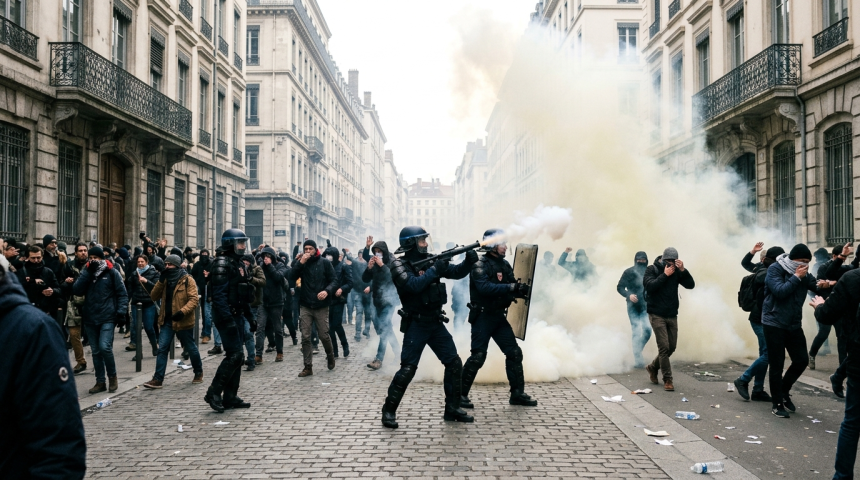
Police fired tear gas at crowds in Lyon as a major march began peacefully in Paris, exposing a sharp contrast between demonstrations in two French cities.
The incidents unfolded during marches in Paris and Lyon, France’s third-largest city. Details about injuries, arrests, crowd size, and the reason for the demonstrations were not immediately available.
Different Scenes in Paris and Lyon
The start of the main Paris march was peaceful. That offered an early sign that demonstrators and police were avoiding direct confrontation in the capital.
Lyon presented a different picture. Police used tear gas against crowds, marking a clear escalation in the official response there.
“Police fired tear gas at crowds in Lyon.”
The available information does not explain what prompted officers to deploy the gas. It also does not establish whether violence, property damage, or other disorder occurred beforehand.
That missing context matters. Tear gas may be used to disperse crowds or create distance between officers and demonstrators. Its use can also spread distress through nearby streets, affecting peaceful marchers, residents, and passersby.
Why the Contrast Matters
Paris often draws the largest share of attention during national demonstrations. Events elsewhere can develop differently because of local crowd movements, police decisions, and conditions along each route.
The split between a calm opening in Paris and tear gas in Lyon shows why a national protest cannot be judged from one city alone. A peaceful procession in the capital does not rule out conflict elsewhere.
Several facts will be needed to assess the Lyon response:
- What happened immediately before tear gas was fired
- Whether police issued warnings or dispersal orders
- How many people were affected, injured, or detained
- Whether march organizers reported clashes or disruption
Without those details, firm conclusions about responsibility would be premature. Police may argue that crowd-control measures were needed to protect public safety. Demonstrators may question whether the response was proportionate.
Attention Turns to Official Accounts
Statements from local authorities, police, emergency services, and march organizers could clarify the sequence of events. Images recorded by journalists and witnesses may also help establish what happened before the gas was deployed.
Any inquiry will likely focus on timing and proportionality. Investigators would need to determine whether officers faced an immediate threat and whether less forceful options were available.
The peaceful start in Paris remains an important part of the story. It suggests that large gatherings did not produce the same result everywhere. Lyon’s confrontation, however, may shape public debate if reports of injuries, arrests, or disputed police conduct emerge.
For now, the clearest takeaway is the contrast itself: calm at the main Paris march, and tear gas on the streets of Lyon. The next official accounts will determine whether that gap reflected local disorder, policing choices, or a mix of both.