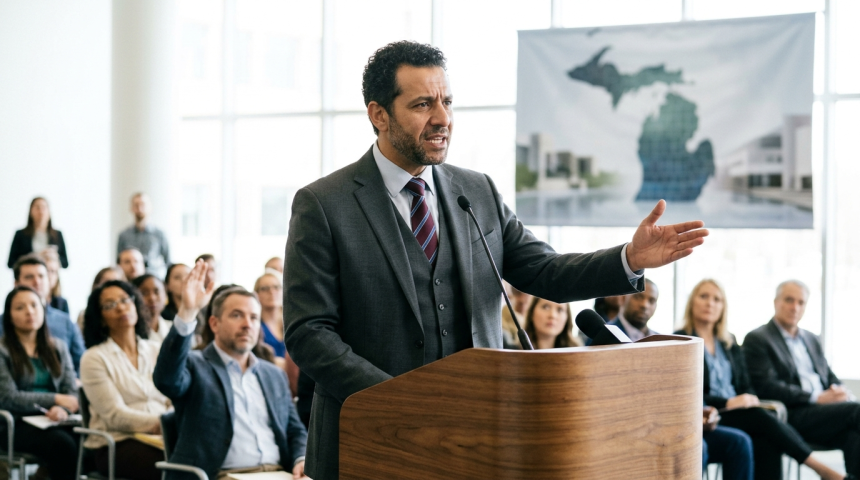
A Michigan Senate hopeful is challenging repeated questions about the Muslim Brotherhood, Israel and personal faith amid rising concern about Islamophobia. The dispute has placed religious identity and campaign fairness at the center of the race.
The candidate has questioned the premise behind the repeated inquiries rather than accepting them as neutral tests. That response raises a wider issue for Michigan voters: when does legitimate policy scrutiny become suspicion based on religion?
Questions Carry Different Political Weight
Questions about Israel can address foreign policy, military aid, civilian protection and the rights of Israelis and Palestinians. Those are standard subjects for candidates seeking federal office.
Questions about the Muslim Brotherhood may also involve national security or foreign affairs. Yet repeated efforts to connect a Muslim candidate with the organization can imply an association without evidence.
Faith presents another concern. A candidate’s beliefs may help voters understand personal values. Religious questioning can become discriminatory, however, if it suggests that Muslim officeholders have divided loyalties.
The Michigan hopeful has challenged the premise of repeated questions about the Muslim Brotherhood, Israel and faith.
That challenge does not place those topics outside public debate. Instead, it asks whether similar standards are applied to candidates of other religions.
Michigan’s Muslim Communities Shape the Debate
Michigan has some of the nation’s most visible Arab American and Muslim communities. Their political influence has grown through local organizing, voter registration and campaigns centered on civil rights and foreign policy.
That influence has also brought close scrutiny. Muslim candidates often face questions about terrorism, overseas organizations or loyalty that Christian and Jewish candidates may not encounter in the same way.
The central distinctions are important:
- Policy questions examine a candidate’s stated positions and proposed actions.
- Evidence-based questions examine documented relationships, funding or public statements.
- Identity-based questions treat religion or ethnicity as evidence of hidden motives.
Critics of faith-based scrutiny may view the repeated questioning as part of a broader pattern of Islamophobia. Supporters of aggressive vetting may argue that candidates should answer difficult questions about international conflicts and political movements.
Both concerns can be addressed through consistent standards. Reporters, opponents and voters can ask direct questions while explaining why each one is relevant. They can also avoid treating religious affiliation as proof of political allegiance.
Israel Debate Intensifies Campaign Pressure
Israel has become a defining campaign issue for many voters, particularly as public debate focuses on war, civilian deaths, antisemitism and anti-Muslim hatred. Candidates may face pressure to reduce complex positions to simple declarations of support or opposition.
That approach can obscure major policy differences. A candidate may support Israel’s security while criticizing its government. Another may advocate Palestinian rights without endorsing armed groups. Clear follow-up questions can reveal those distinctions.
The same care applies to the Muslim Brotherhood. The organization has branches and political histories across several countries. A question that uses the name without identifying a specific claim risks creating suspicion rather than useful information.
Fair Scrutiny Requires Evidence
The controversy offers a test for Michigan’s political institutions. News organizations must examine candidates closely, but scrutiny is most useful when tied to records, votes, affiliations and policy proposals.
Rival campaigns also have a duty to separate criticism from insinuation. Voters can then judge the candidate’s answers instead of being asked to infer guilt from religious identity.
The Senate hopeful’s challenge may influence how future questions are framed. The key issue is not whether candidates should face tough examination. It is whether that examination rests on evidence and is applied equally.
As the campaign continues, attention will turn to the candidate’s policy positions and any factual basis for the disputed questions. The broader outcome could shape how Muslim candidates are covered in Michigan and across the country.