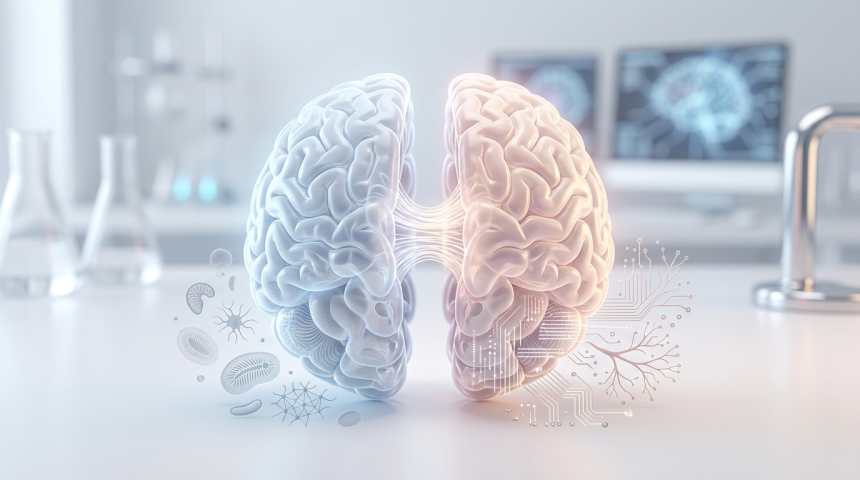
Stanford University scientists say the human brain may be better understood as two closely linked organs with distinct origins and jobs.
The research separates the brain into a hindbrain system that manages vital functions and a forebrain system tied to language, thought, and consciousness. The findings offer a fresh framework for studying how human cognition developed and how brain disorders may affect different systems.
The phrase “two separate organs” is striking, but it does not mean people carry two independent brains. Instead, the researchers describe systems that arose along different paths before becoming tightly connected. Think less “two brains in a trench coat” and more “two specialist departments sharing one very busy office.”
Two Systems With Different Duties
The hindbrain sits near the spinal cord and controls many processes needed for survival. These include breathing, heart regulation, balance, sleep, and basic movement.
Many of those functions happen without conscious effort. A person does not need to remember to breathe while reading a sentence or walking across a room.
The forebrain supports more complex activity. It includes regions involved in memory, planning, emotion, sensory processing, and decision-making. In humans, it also supports advanced abilities such as speech and abstract thought.
One system controls “vital functions like breathing,” while the other handles “higher-level thinking like language and consciousness,” according to the Stanford scientists.
The division is not absolute. Brain regions constantly exchange signals, and basic survival systems can shape thought and emotion. Fear, for example, can change breathing and heart rate. Slow breathing can also influence attention and stress.
An Evolutionary Split Comes Into Focus
Scientists have long divided the brain by anatomy and development. The forebrain, midbrain, and hindbrain form early in an embryo, then develop into more specialized structures.
The Stanford findings place greater weight on the different origins of the forebrain and hindbrain. That approach could change how researchers describe the brain’s history. Rather than treating it as one organ that added new features over time, the model suggests two ancient systems may have joined and learned to cooperate.
The broad contrast can be summarized this way:
- The hindbrain keeps core body processes running.
- The forebrain supports perception, planning, language, and conscious experience.
- Connections between them turn separate tasks into coordinated behavior.
This view also fits a common pattern in evolution. New biological abilities often develop by modifying or linking older systems, not by replacing them. Human reasoning may depend on newer neural structures, but it still relies on ancient circuits that regulate wakefulness, movement, and survival.
Why the Distinction Matters
A two-system model could help scientists classify neurological and psychiatric conditions more precisely. Damage to the hindbrain may disrupt breathing, coordination, swallowing, or sleep. Changes in forebrain networks may affect memory, language, judgment, or awareness.
The framework may also guide research into consciousness. Higher thought cannot operate without the systems that maintain alertness and regulate the body. That means consciousness may be less like a single switch and more like cooperation between several levels of the nervous system.
Still, the “two organs” description should be treated as a scientific interpretation, not a settled replacement for standard anatomy. The brain remains physically connected and highly integrated. Researchers will need more evidence to show how far the distinction reaches across species, development, and disease.
The central finding is both simple and consequential: breathing and language may belong to systems with different histories, even though daily life binds them together. Future studies will need to test whether this model improves diagnosis, treatment, and theories of consciousness. For now, Stanford’s research offers a sharper question about the organ inside every skull: whether one brain is, in some meaningful sense, a partnership of two.