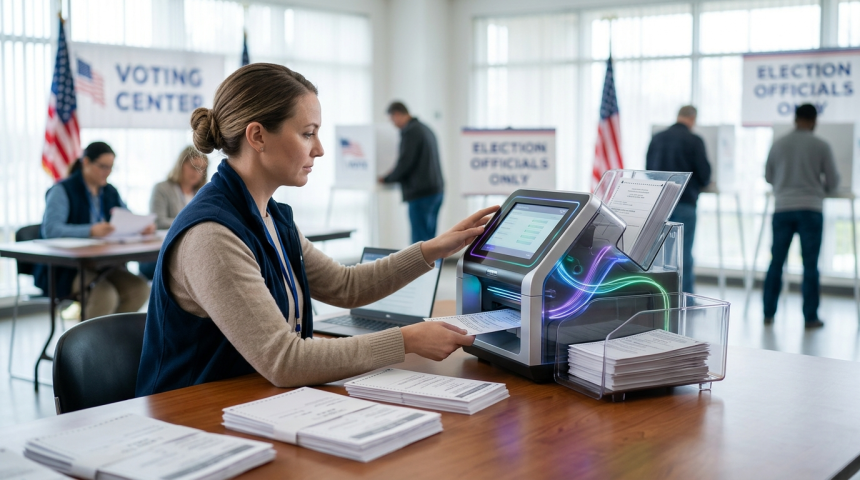
Quantum mechanics may offer a new way to verify election totals while keeping each voter’s choice secret. The concept addresses a central challenge in democratic elections: proving that every valid ballot was counted without exposing how any person voted.
The proposal links two goals that can pull in opposite directions. Election officials need enough transparency to earn public trust. Voters also need privacy, which protects them from pressure, retaliation, and vote buying.
The Tension Between Privacy and Verification
Traditional elections rely on procedures, observers, audits, and secure ballot handling. Paper ballots can be recounted, but officials must protect identifying information. Electronic systems can count quickly, yet software errors or attacks may be hard for voters to detect.
The core question is simple:
“How can you make sure that everyone’s votes are counted but also kept entirely secret?”
A credible system must let a voter confirm that a ballot entered the count. It must also prevent that voter from proving the ballot’s contents to another person. That second condition matters because proof could enable coercion or payments for votes.
Election security experts often separate verification into several tasks:
- Confirm that eligible voters can cast one valid ballot.
- Show that recorded ballots are included in the final total.
- Protect individual choices from officials, attackers, and other voters.
- Allow independent checks without revealing private information.
How Quantum Voting Could Work
Quantum systems use properties of very small particles to store or transmit information. Measuring a quantum state can alter it. That behavior may help detect secret observation or unauthorized changes.
In a possible voting system, quantum information could represent ballots or support the secure exchange of voting credentials. Built-in checks might reveal whether someone intercepted or changed information before counting.
Quantum methods could also support a shared count without giving one authority complete control. Several election officials or institutions might take part in verification. No single participant would necessarily gain access to an individual vote.
However, the idea does not mean election results would be accepted on physics alone. Any practical system would still require clear rules, identity checks, reliable equipment, trained workers, and public oversight.
Practical Barriers Remain
Quantum technology is difficult to deploy outside controlled settings. Quantum states are fragile, and specialized equipment can be expensive. Communication failures or faulty hardware could interrupt voting and weaken public confidence.
Accessibility presents another concern. A voting system must serve people with disabilities, voters in remote areas, and citizens who lack advanced devices. Security gains would carry little value if the system made voting harder.
Trust is also a social issue. Most voters cannot inspect quantum hardware or verify its physics themselves. Election authorities would need plain explanations, independent testing, open procedures, and a dependable way to resolve disputes.
There are further risks outside the counting process. Quantum protection would not automatically stop voter registration errors, misinformation, intimidation, insider misconduct, or denial-of-service attacks. Election security depends on the full process, not one technical layer.
A Tool Rather Than a Complete Solution
Quantum voting research points to a useful standard for future elections: the count should be open to verification while the ballot remains private. That standard could guide both quantum and conventional systems.
Before any public election uses such methods, researchers would need to demonstrate accuracy under real conditions. Independent experts would also need to test failure scenarios and compare the system with paper ballots and established audit practices.
Quantum mechanics may help reconcile ballot secrecy with public verification. Yet adoption will depend on more than scientific promise. Cost, access, legal safeguards, operational resilience, and public understanding will decide whether the idea can move from theory to the polling place.