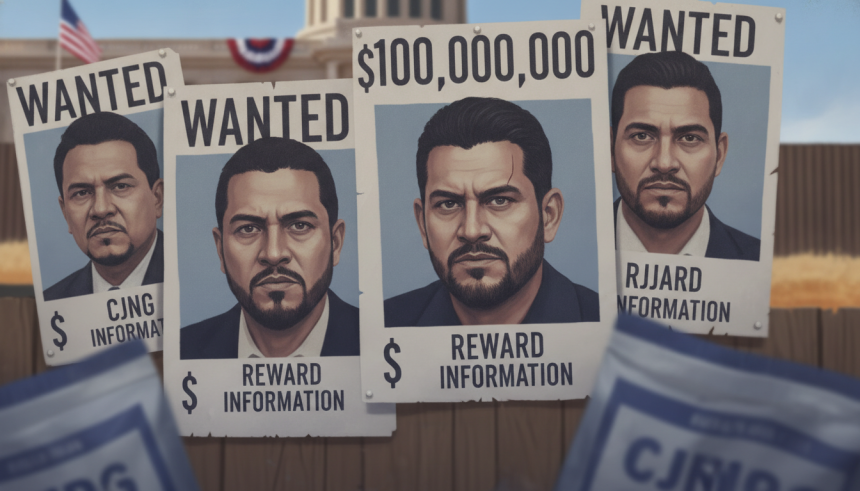
The United States intensified pressure on Mexico’s Jalisco New Generation Cartel by offering a total of $100 million in rewards for its leadership. The move, made under the Trump administration, signaled a sharper focus on top-tier figures in one of the most violent and fast-growing criminal groups in the hemisphere. It aimed to spur tips, disrupt cartel command, and slow the flow of synthetic drugs into the United States.
Officials linked the offers to cross-border crime, fentanyl and methamphetamine trafficking, and a surge in homicides in regions where the cartel operates. The decision marked an escalation in the use of reward programs as a tool in drug enforcement. It also placed new pressure on U.S.-Mexico cooperation at a time of heightened tensions over security and migration.
The Trump administration offered a total of $100 million in rewards for various leaders of the Jalisco New Generation Cartel, or CJNG.
A Cartel on the Rise
CJNG emerged from the fractures of older criminal groups in western Mexico over the past decade. Security analysts describe the group as heavily armed, expansionist, and adaptable. It has a presence in multiple Mexican states and supply routes that reach into the United States and overseas markets.
Officials in both countries have linked CJNG to synthetic drug production and distribution. The U.S. timeline shows rising overdose deaths linked to fentanyl in recent years. In response, American agencies have leaned on sanctions, extraditions, and rewards to target alleged kingpins and financial networks.
Mexico has mounted major raids and arrests, though convictions at the top level remain rare. Experts say fragmentation, local corruption, and uneven policing make long-term gains hard to secure.
The Strategy Behind Rewards
Reward offers have long been part of U.S. counter-narcotics policy. They are designed to encourage informants and create pressure inside criminal groups. Larger amounts aim to draw tips on senior leaders, safe houses, and logistics hubs.
Security practitioners say the approach can work when paired with strong investigations, witness protection, and cross-border coordination. Without those, tips may dry up or lead to short-lived results that do not dent production and trafficking.
- Rewards can trigger internal splits that weaken command.
- They may also prompt retaliatory violence if groups suspect informants.
- Success depends on swift action once leads arrive.
Former law enforcement officials caution that publicized bounties raise expectations. Communities in contested regions may face reprisals unless authorities provide sustained protection and services after raids.
Impact on U.S.-Mexico Cooperation
Close work between U.S. and Mexican agencies is vital for using tips and moving on targets. Cooperation has shifted over the years due to political tension, changes in law, and public backlash to heavy-handed tactics.
Analysts in Mexico argue that arrests alone do not reduce violence. They point to the need for judicial reform, anti-corruption work, and local economic support. U.S. officials counter that neutralizing top figures can reduce supply and degrade command structures when paired with financial sanctions and precursor controls.
Both sides face a shared problem: synthetic drugs require smaller supply chains than plant-based narcotics. This lowers the barrier to entry for new groups and makes leadership decapitation less decisive.
Measuring Results and Risks
It is difficult to measure the effect of high-dollar rewards in the short term. Some operations do lead to captures, but overall trafficking often rebounds through replacements or splinter cells. The public will be watching for arrests tied directly to the offers and for any drop in overdose deaths linked to CJNG routes.
Community advocates warn that pressure on one cartel can shift violence to rival groups. They call for stronger oversight of security forces and support for victims in regions where CJNG contests territory.
Financial measures remain a key part of the playbook. Freezing assets, tracking money services, and targeting chemical suppliers can complement reward-driven arrests. These steps can slow operations even when kingpins evade capture.
The $100 million figure reflects a bet on intelligence from informants and defectors. It also signals that U.S. agencies see CJNG as a priority target in the fight against synthetic drugs.
The offers stand as one of the largest coordinated pushes against a single cartel’s leadership. The next phase will test whether tips turn into arrests and extraditions, and whether that reduces supply or shifts it elsewhere. Watch for measurable outcomes: named captures, asset seizures linked to CJNG, and changes in overdose data. The stakes are high on both sides of the border, and the results will shape future use of large bounties in anti-cartel strategy.