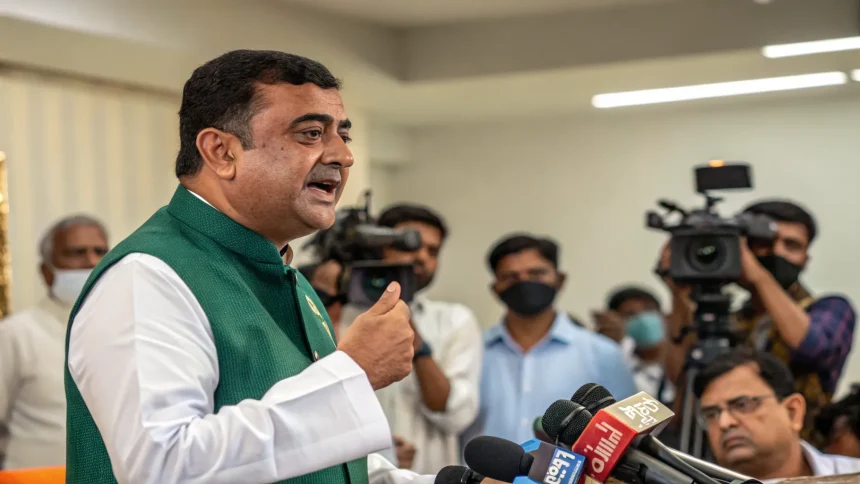
In Kolkata, Bharatiya Janata Party leader Suvendu Adhikari challenged claims of widespread post-poll violence in West Bengal, urging accusers to specify locations and case counts. Speaking amid rising political tension, he cited police figures and past records to argue that the current situation is limited in scale. The remarks come as the Trinamool Congress accuses rivals of targeted attacks after the vote.
Background: A State Scarred by 2021 Clashes
West Bengal has a recent history of unrest linked to elections. In 2021, large-scale violence after the assembly polls drew nationwide attention and led to extensive legal and political fallout. Parties from both sides traded charges, and thousands of people were reported displaced. The memory of that period now frames debate over the latest incidents.
Adhikari leaned on those events to make his case. He contrasted today’s reports with what he described as the scale of 2021, when emergency relief and investigations followed weeks of turmoil.
Adhikari’s Claim: Fewer Complaints This Time
“Tell me where all it is happening, tell me the number of area, the Police Station area, Assembly, district — the outgoing LoP is ready to answer all questions,” Adhikari said.
He said the state’s police leadership had reported a small volume of complaints. He disputed figures shared in public debate and asked for precise details rather than broad charges.
“100 FIRs have not been lodged. DGP told me 50–60 complaints were received; they were small complaints,” he said.
He added that the current reports should not be compared with the earlier cycle of unrest. He insisted the BJP had no need to threaten opponents and framed the party’s vote share as evidence of broad support.
“There has not been much violence. I am not defending any violence, I am not supporting any violence. But don’t compare with TMC,” he said. “BJP doesn’t need to do this. It got 46% votes, in the coming elections it will rise up to 60% votes.”
Revisiting 2021: Displacement and Investigations
Adhikari presented figures to show the impact of the 2021 crisis. He said the BJP had built hundreds of safehouses and that tens of thousands fled their homes. He also pointed to central investigations into sexual violence cases from that period.
- “In 2021, BJP had built 355 safehouses.”
- “1,10,000 people were forced to leave their houses.”
- “61 FIRs were lodged by CBI, they were about rape and attempt to rape.”
- “12,500 FIRs were there.”
Adhikari also referenced visits by national and state figures to relief sites outside West Bengal. He said assistance in Assam included food and shelter for people fleeing violence.
“The then Governor Jagdeep Dhankhar went to Assam with a chopper. In Assam, Himanta Biswa Sarma, the then CM Sarbananda Sonowal provided food and shelter to people.”
Competing Claims and Police Response
The TMC has alleged targeted attacks after the polls and questioned the role of BJP workers in street-level clashes. Adhikari dismissed those accusations and demanded documented cases by jurisdiction. He cited the Director General of Police as the source of the 50–60 complaints figure, adding that they were minor in nature. Independent verification of complaint counts remains key to assessing the situation on the ground.
Police have not issued a comprehensive public tally in this account. The call for detailed, verifiable data continues, as both sides push their narratives and supporters share videos and photos online.
What the Numbers Could Mean
If complaint counts remain in the low dozens, as Adhikari claims, the state may avoid a repeat of the 2021 crisis. If reports rise, pressure on law enforcement and courts will grow. The figures he cited—46% for BJP’s vote share and a forecast of 60%—signal the political stakes behind the messaging on order and safety.
Analysts say two measures will shape public trust: prompt registration of cases and visible protection for vulnerable communities. Transparent updates from the police would help cut through rumor and fear.
For now, Adhikari’s remarks set a clear marker for the debate over post-poll safety in West Bengal. He paints the present as contained and the past as the benchmark for comparison. The coming days will test those claims as officials log complaints, courts review petitions, and parties weigh costs ahead of the next round of elections.