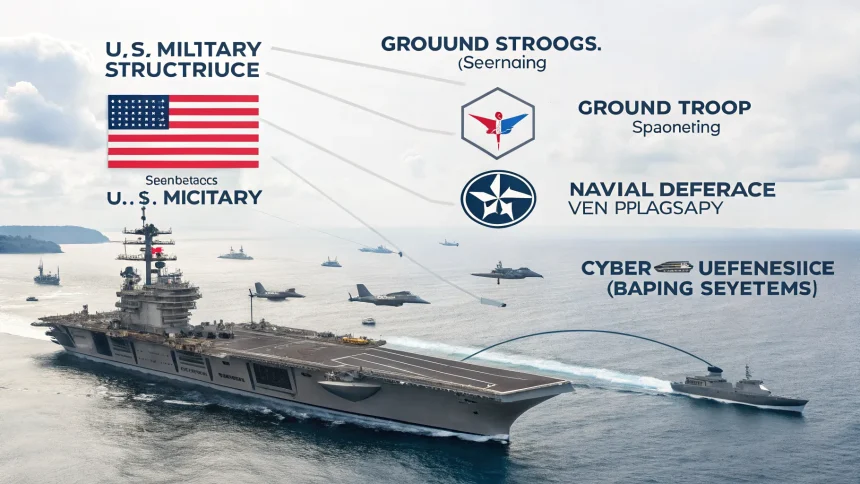
The United States fields the world’s most capable military, organized across six branches and led by a civilian commander-in-chief. As debates on defense spending and strategy grow, understanding how the force is built and led helps explain its reach and its limits.
At the center of the system is the president, who directs the armed forces. The services—Army, Marine Corps, Navy, Air Force, Space Force, and Coast Guard—carry out missions on land, at sea, in the air, and in space. The country also spends more on defense than any other nation, shaping global security and domestic priorities.
What the Force Includes
“Considered the world’s most powerful military forces, the U.S. military is made up of six branches: the Army, Marine Corps, Navy, Air Force, Space Force, and Coast Guard.”
The Army handles large-scale ground operations. The Marine Corps pairs rapid response with amphibious capability. The Navy secures sea lanes and projects power from carrier strike groups and submarines. The Air Force dominates the air domain with fighters, bombers, and mobility aircraft. The newest service, the Space Force, protects satellites and space-based systems that guide communications, navigation, and targeting. The Coast Guard focuses on maritime safety, security, and law enforcement, and can serve under the Navy in wartime.
Special operations units across the services conduct high-risk missions. The National Guard and Reserve add surge capacity at home and abroad. This structure allows the military to respond to crises, deter adversaries, and support allies.
Civilian Control and the Chain of Command
“The president is the commander-in-chief of the U.S. military.”
America’s system places the armed forces under elected leaders. The president sets strategy and authorizes operations. The Secretary of Defense, a civilian, manages the Pentagon and policy. The Joint Chiefs advise but do not command forces in the field. Combatant commanders direct missions by region or function.
This model aims to balance military expertise with democratic oversight. Congress funds the force, confirms senior leaders, and can authorize or limit deployments. Courts and inspectors general provide added checks.
Spending and Global Reach
“It’s ranked first in government spending.”
The United States spends more on defense than any other country. That money supports personnel, training, research, and equipment from fighter jets to cyber defenses. It also funds a worldwide network of bases and partnerships that support operations and deterrence.
Analysts point to several drivers of cost: a volunteer force with rising pay and benefits, aging platforms that need replacement, and newer demands such as missile defense and space operations. Independent studies often note that the U.S. share of global military spending is the largest by far, reflecting these ambitions and commitments.
- Strengths: global logistics, advanced technology, and experienced personnel.
- Pressures: modernization bills, recruitment and retention, and oversight of large programs.
Recent Changes and Ongoing Debates
The creation of the Space Force signaled how vital satellites and space assets have become. Cyber units are also growing, reflecting threats to power grids, financial systems, and military networks. At sea, the Navy weighs fleet size against maintenance backlogs. On land and in the air, the services juggle readiness with upgrades to armor, airframes, and munitions.
Critics question whether high spending matches clear goals. Supporters argue that forward presence and advanced systems prevent wars from starting. Lawmakers press the Pentagon on waste, audit results, and program delays. Veterans groups call for steady funding for healthcare and family support.
What to Watch Next
Recruitment trends and training pipelines will shape future readiness. Modernization plans for nuclear forces, hypersonic weapons, and air defense will test budgets and timelines. The balance between conventional forces and new domains—space and cyber—will drive strategy.
Allies and partners look for consistent U.S. engagement. Adversaries probe for gaps in deterrence. In this environment, clear goals, accountable spending, and a well-supported force will decide how the United States maintains its edge.
The core facts remain clear: six branches, a president in command, and the world’s largest defense budget. How leaders align those pieces with strategy will define the next chapter.