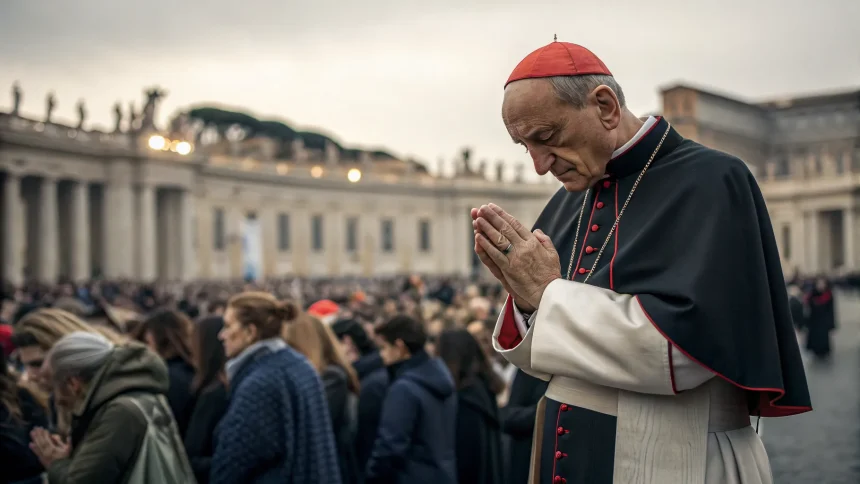
As crowds filed past Pope Francis’s body in the Vatican last week, a Peruvian cardinal under Church sanctions joined mourners in silent prayer. His presence, eyes downcast and hands clasped, stood out during a solemn rite that drew leaders and laypeople from across the world. The Vatican had confirmed in January 2025 that a “penal injunction” was in place following the cardinal’s resignation.
The sight of the prelate at the vigil highlighted an unresolved question for the Catholic Church. How should sanctioned figures appear at major public ceremonies, especially those honoring a pope? The case has renewed attention on Church discipline, transparency, and expectations for accountability.
A Public Appearance Under Sanction
Vatican rites for a deceased pope are among the most visible events in global religion. The lying in state attracts vast lines of mourners. Clergy from many countries come to pay respects. That included the Peruvian cardinal, who has faced scrutiny in recent years.
In January 2025, the Holy See acknowledged media reports and said a measure had been applied after the prelate stepped down. The statement used a specific term from Church law:
“Penal injunction.”
While details were not provided in that confirmation, the phrase signals a formal restriction under canon law. Such measures can limit public ministry, bar certain functions, or require specific acts of reform. The scope varies by case, and enforcement is usually overseen by Church authorities.
What a Penal Injunction Can Mean
Canon law allows penalties to address misconduct or negligence. They can be temporary or long term. They are designed to protect the faithful, correct wrongdoing, and repair harm.
- Restrictions may include bans on public liturgy or governance roles.
- Obligations can require cooperation with investigations or pastoral directives.
- Measures often remain confidential unless the Holy See decides to disclose them.
Resignation can be part of a broader response. It removes an official from leadership while other limits remain in force. Public appearances at major events are sometimes permitted, but participation can be limited to private prayer without ceremonial duties.
Balancing Mourning and Accountability
The moment at St. Peter’s underscored a tension facing the Church. It must honor a deceased pope while signaling clear standards for officials under discipline. Visibility at a global rite can send mixed messages if not carefully managed.
Church leaders often weigh pastoral needs against the risk of confusion. Allowing a sanctioned figure to attend in a non-official capacity may be seen as an act of mercy. Yet critics argue that clear boundaries are needed to maintain trust.
The Vatican has worked in recent years to strengthen accountability. Measures have included clearer procedures for handling misconduct and expanded roles for lay experts. Public communication, however, remains cautious. Confidentiality rules and legal considerations often limit what can be shared.
Why This Moment Matters Now
A papal funeral period is a time of unity and reflection. It is also a time when long-running issues return to view. The presence of a sanctioned cardinal at such a visible rite points to key questions:
- How transparent should the Church be about penalties and their terms?
- What roles, if any, are appropriate for disciplined clergy at high-profile events?
- How can pastoral care for the person coexist with care for those harmed?
Answers may differ by case. Still, consistency and clarity will shape public confidence. The Church’s approach in the coming weeks could set expectations for future events.
What To Watch Next
Attention now turns to whether the Holy See provides further guidance on public participation by sanctioned officials. Clear norms could reduce uncertainty at large ceremonies. They could also help bishops and event planners apply rules in a uniform way.
Any update might outline permitted activities, such as private prayer, and list barred actions, such as presiding at liturgies or receiving honors. It could also detail who decides exceptions and how they are documented.
For many Catholics, the focus remains on prayer for the late pope and the Church’s mission. Yet moments like this show how symbols carry weight. Decisions at the intersection of mourning and discipline will shape how that mission is seen.
The key facts are straightforward. A Peruvian cardinal who resigned and is under a penal injunction joined mourners for Pope Francis at the Vatican last week. The image raised sensitive questions. The next steps—whether new guidance or case-by-case decisions—will show how the Church balances mercy, clarity, and accountability in public view.