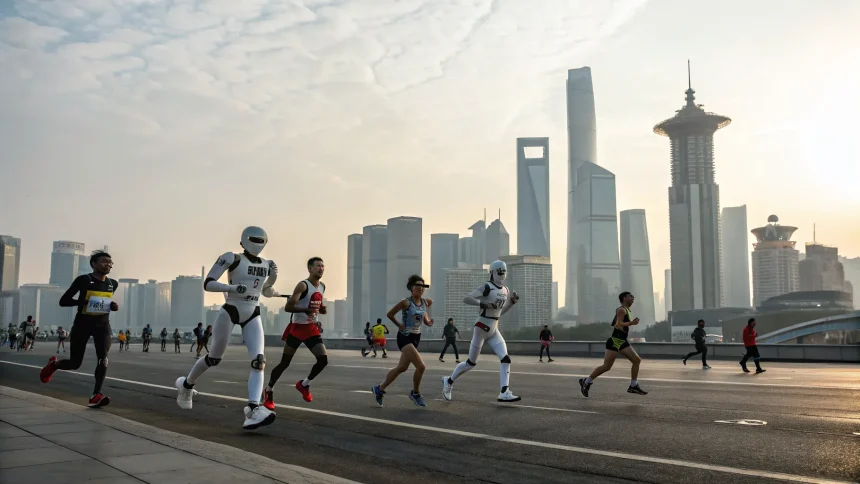
On a city course in Beijing, dozens of humanoid robots sped past human athletes during a half-marathon, offering a vivid look at how machines now match stamina and pace in public events. The scene, unusual even in a country known for rapid tech adoption, raised fresh questions about safety, rules, and the role of autonomous systems in sports and mass gatherings.
Witnesses described packs of machines moving swiftly among traditional runners. The event took place in China’s capital during a half-marathon, a 21.1-kilometer race that typically blends elite competition with community participation. Organizers did not release times or placements for the robots, but the visual contrast drew instant attention.
“Dozens of humanoid robots whizzed past human runners in a half-marathon race in Beijing, China.”
Background: Tech on the Street
Public road races often serve as stages for new technology. Wearable sensors, live tracking, and mobile support tools are now standard at large events. China has also invested in artificial intelligence and robotics across transport, logistics, and municipal services. Showing robots on a crowded course suggests a push to test mobility and control in a real-world setting, not just in a lab.
Humanoid robots are designed to move on two legs and navigate complex terrain. That design makes them well suited for sidewalks, curbs, and uneven surfaces that wheeled systems may avoid. A half-marathon presents a sustained endurance test across varied conditions.
What the Robots Might Have Demonstrated
Without official metrics, the clearest evidence is the visual performance: sustained speed and reliable balance. If the robots maintained pace through turns, hydration zones, and crowds, that points to advances in:
- Battery life and thermal control during prolonged exertion.
- Real-time navigation in dense, dynamic environments.
- Gait stability and recovery after jostling or surface changes.
Such capabilities matter far beyond sports. City agencies look to autonomous systems for last-mile delivery, facility inspection, and emergency response. A machine that can keep tempo over distance may also handle patrol routes, warehouse runs, or hospital supply loops.
Safety, Rules, and Ethics
Mixing robots with runners raises clear concerns. Event operators must protect participants from collisions, falls, and overheating hardware. Course density, reaction time, and fail-safes all come into play. Without a public rulebook, it is unclear whether the robots were fully autonomous, remote-supervised, or restricted to certain lanes.
Sports bodies face a second issue: fairness. If times or rankings were recorded, should machines appear on the same results sheet as people? Many organizers may opt for demonstration-only status, separate start waves, or parallel exhibitions. Clear labeling and barriers would help spectators understand what they are watching and where to stand safely.
Public Reaction and City Strategy
Images of robots outpacing people can spark both excitement and worry. Supporters may see proof that machines can operate safely at human speed. Skeptics may question job impacts or the value of tech displays in community races. City planners, however, often test new systems where they can observe crowd behavior, signage needs, and emergency access.
Beijing has hosted large-scale events that require tight coordination across traffic control, medical stations, and volunteers. Adding humanoid systems to that mix could inform future guidelines for permits and insurance, as well as vendor standards for hardware and software.
What to Watch Next
The next steps will likely include more detail from organizers about how the robots were controlled, what safety buffers were used, and whether any incidents occurred. Technical briefings on battery endurance, obstacle detection, and remote overrides would help the public judge risk.
Racing groups may also consider pilot rules for non-human entrants. Separate start corrals, pacing limits, or off-peak demonstrations could balance curiosity with caution. Cities may push for certification standards that mirror those used in autonomous vehicles and drones.
The sight of humanoid robots gliding past human runners signals rapid progress in mobility and control. It also shows how public spaces are becoming test beds for automation. The big questions now are not about speed alone, but about how to set rules that protect people while allowing careful trials. Expect more staged runs, stricter protocols, and a growing debate over where machines belong on the road.