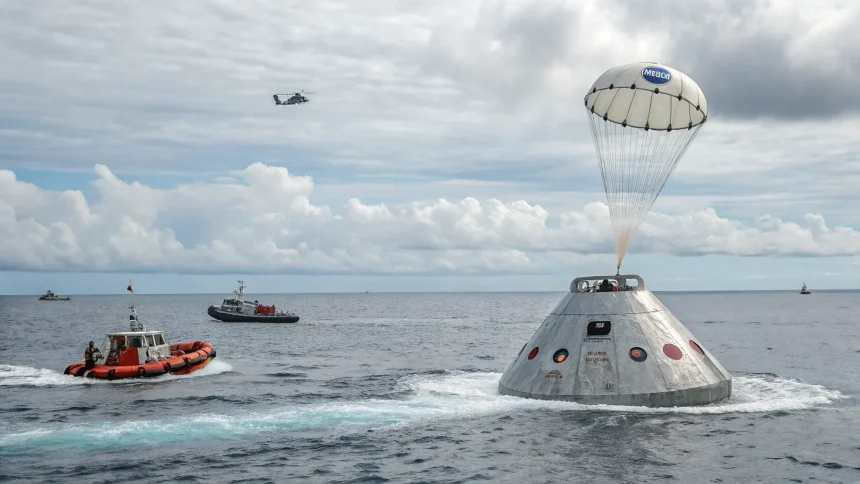
NASA’s Orion capsule returned to Earth with a splash in the Pacific Ocean on Friday evening, closing an important test for the agency’s lunar program. The touchdown just after 8 p.m. Eastern marked the end of a mission designed to check critical systems before future flights that aim to send astronauts around the Moon and back.
The splashdown occurred in designated waters and followed a planned reentry, parachute deployment, and recovery sequence. The event serves as a checkpoint for the Artemis effort, which seeks to build a steady path for human exploration of the Moon.
What the Test Proved
“NASA’s Orion module splashed into the Pacific Ocean just after 8 p.m. Eastern on Friday, concluding an important test for the Artemis program.”
Orion’s ocean landing is a key part of its design. The capsule relies on a heat shield to survive reentry, followed by a series of parachutes to slow its descent. A smooth splashdown indicates that guidance, navigation, communications, and recovery planning worked as intended.
NASA typically monitors dozens of checkpoints during return. These include capsule orientation, parachute timing, and structural loads during touchdown. The result informs upgrades, if needed, before the next mission on the schedule.
Why It Matters for Artemis
Orion is the crew vehicle for the Artemis program, which aims to return astronauts to the lunar vicinity and build long-term operations near the Moon. Each test is designed to reduce risk for missions that will carry people. A clean return helps verify that the capsule can handle the high-speed reentry required after a voyage from the Moon.
Agency planners have emphasized the importance of repeatability. They want the vehicle to perform in a consistent way from launch through landing. An ocean recovery allows teams to secure the capsule, download data, and inspect hardware soon after splashdown.
How Orion Returns Safely
Bringing a spacecraft home from deep space is demanding. Engineers prepare for extreme heat, rapid deceleration, and shifting winds over the ocean. Orion’s heat shield is built to endure temperatures of several thousand degrees Fahrenheit. Its parachute system deploys in stages, with drogue chutes followed by three main canopies to slow the capsule for water landing.
- Reentry: High-speed descent through Earth’s atmosphere.
- Parachutes: Drogues stabilize, mains slow to splashdown speed.
- Recovery: Teams locate, secure, and transport the capsule to port.
Data from sensors across the capsule show how each phase performed. Engineers compare this with predictions to confirm safety margins.
Background and Recent History
Orion has completed uncrewed flights before, including a high-altitude Earth orbit mission and a lunar voyage in recent years. Those flights demonstrated guidance, navigation, and life-support systems in space. Each new test focuses on closing remaining gaps, such as refining heat-shield performance and streamlining recovery operations.
The Artemis program also involves heavy-lift rockets, ground systems, and planned lunar hardware. Progress in one area often depends on results in another. A reliable crew capsule is central to the plan.
What Comes Next
Following every splashdown, NASA teams recover the capsule and begin detailed inspections. Technicians study the heat shield’s outer layer, parachute hardware, and avionics. They also review communications logs and navigation data to confirm the vehicle’s performance in real conditions.
That analysis informs go-or-no-go decisions for future crewed missions. It can also guide updates to training for flight controllers and recovery crews. If the findings match expectations, Orion moves closer to carrying astronauts on its next flight profile.
Friday’s splashdown delivers a clear message: the return phase, one of the most unforgiving parts of spaceflight, proceeded to plan. The focus now shifts to what the data show and how quickly teams can apply lessons learned. If the results hold up under review, the Artemis campaign gains momentum, with eyes on the next launch window and the long journey back to the Moon.