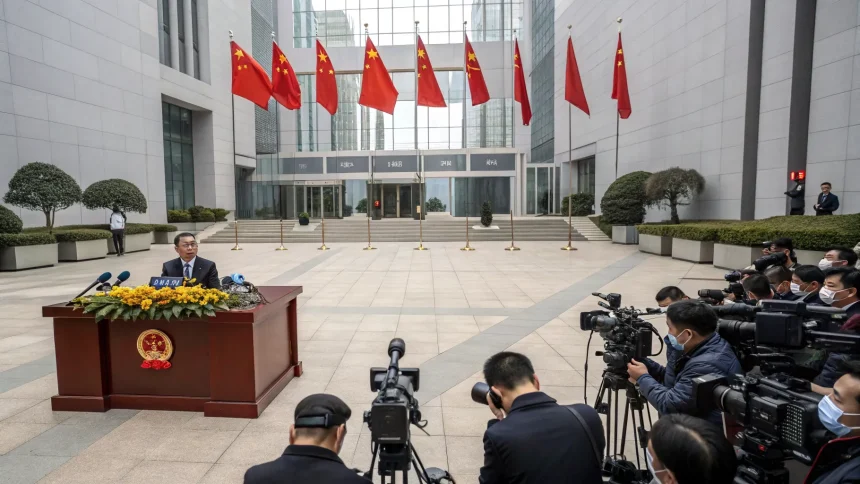
China’s Foreign Ministry condemned a fresh U.S. trade investigation by the Trump administration, calling it a pretext for more tariffs, even as Beijing advances a new five-year plan likely to unsettle major trading partners. The clash highlights rising tensions over market access, subsidies, and control of key technologies, with both sides signaling few signs of compromise.
Beijing’s Response and Rising Friction
At a briefing in Beijing, a Foreign Ministry spokesperson said Washington’s move is unjustified and politically driven. The remark framed the inquiry as part of a wider campaign to constrain China’s industrial ambitions.
China criticized the investigation as a “pretext” for tariffs.
U.S. officials have long argued that China’s state support, limited access for foreign companies, and technology transfer pressures hurt American firms. Previous probes led to successive rounds of tariffs. By 2019, duties covered more than $300 billion in Chinese goods, and China retaliated on a comparable scale.
Background: From Investigation to Tariffs
The dispute traces back to a U.S. investigation into China’s trade and intellectual property practices under a rarely used legal tool. The findings paved the way for tariffs that reshaped supply chains and forced companies to rework sourcing plans.
Economists say the measures raised costs for importers and consumers, while also steering investment to Southeast Asia and Mexico. Despite the duties, two-way goods trade between the U.S. and China remained large, reflecting deep ties that are difficult to unwind quickly.
What the Five-Year Plan Signals
China’s current planning cycle emphasizes self-reliance in advanced manufacturing and critical technologies. Officials highlight semiconductors, clean energy, electric vehicles, batteries, and artificial intelligence as strategic priorities. The plan also stresses domestic demand, infrastructure upgrades, and rural revitalization.
Trade partners worry that fresh state support could intensify global competition and add to gluts in sectors like solar panels and EVs. European officials have already opened subsidy probes into Chinese-made electric cars, signaling harder scrutiny ahead.
Global Reactions and Market Concerns
Business groups say renewed tariff talk creates uncertainty for investors weighing long-term projects. Companies that shifted orders out of China during earlier rounds fear a new escalation could trigger more supply disruptions.
- Manufacturers cite freight costs and compliance risks as top concerns.
- Retailers warn of higher prices if new duties take effect.
- Tech firms worry about export controls and licensing delays.
Some analysts argue the U.S. and its allies are moving to align responses, with more targeted tools such as investment screening and sector-specific restrictions. Others caution that overlapping measures could fragment trade and slow innovation.
China’s Message to Partners
Beijing has tried to reassure foreign investors by expanding “encouraged” investment lists and pledging equal treatment for domestic and foreign firms. Officials say the country remains open for business and aims to improve its business climate.
At the same time, the emphasis on domestic technology capacity sends a clear signal. China wants to reduce exposure to external pressure points, especially in chips and core software. That objective could collide with global rules if state support fuels sharp price undercutting in export markets.
Economic Stakes and Scenarios
The economic stakes are large. China remains the world’s top goods exporter, and the U.S. is a leading consumer market. Tariffs and countersanctions can ripple through logistics, raw materials, and final assembly across multiple countries.
Three plausible paths stand out:
- Limited escalation, with symbolic tariffs and negotiations that pause further action.
- Broader duties covering more categories, raising costs and shifting trade to third countries.
- Targeted sector measures, focusing on EVs, batteries, and solar, with subsidy probes and quotas.
Any of these outcomes would challenge firms that rely on just-in-time production or narrow supplier networks.
Competing Narratives
Chinese officials frame the U.S. investigation as protectionism. They argue that industrial policy is a normal tool for development. U.S. officials counter that fair competition requires transparent subsidies, market access, and protection of intellectual property.
Trade experts note that both sides are doubling down on strategic sectors. That increases the odds of more trade remedies, even if headline tariff rates do not surge.
The immediate clash over the investigation and Beijing’s planning priorities reflects a deeper contest over the rules of global commerce. For now, neither side appears ready to retreat. Investors should watch for new tariff lists, subsidy probes in Europe and the U.S., and updates on China’s industrial targets. The next phase of this dispute will likely turn on how far governments go in shielding strategic industries—and how quickly companies can adapt.