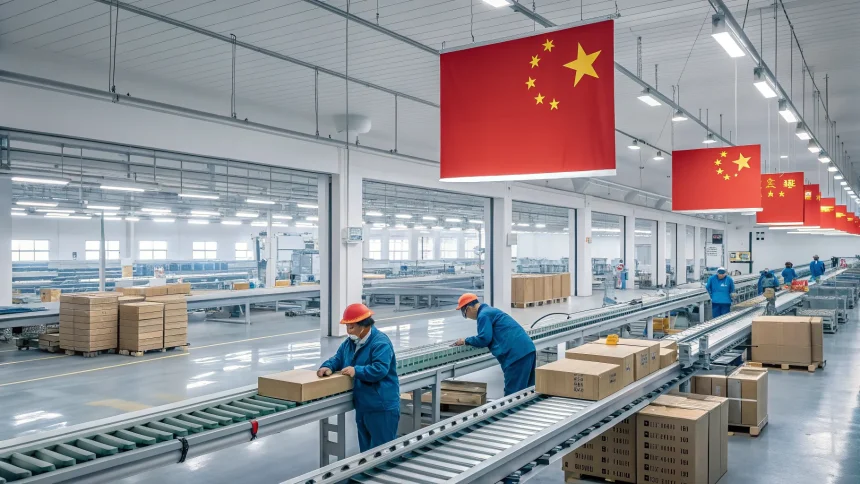
China is signaling a shift as growth cools and a once-reliable export machine shows strain. The move comes after years of trade-driven expansion and amid global demand uncertainty. The change matters for factories at home and for supply chains around the world.
“It’s an acknowledgment that growth in the world’s second-biggest economy is slowing as its export-led model starts to reach its limits.”
Officials and advisers have hinted at a stronger push toward domestic demand, services, and advanced manufacturing. The timing aligns with patchy consumer spending, weaker property activity, and trade tensions that weigh on orders.
Why the Old Model Is Struggling
China’s rise was powered by low-cost manufacturing and surging overseas sales. That strategy worked while the world absorbed ever more goods and firms shifted production to the mainland. But several forces now press on that model.
Higher wages have narrowed cost advantages in some sectors. Geopolitical rifts and tariff measures have disrupted trade. Buyers in the United States and Europe have diversified suppliers, moving some production to Southeast Asia or Mexico. At home, a property slump has chilled investment and cut household wealth, curbing spending power.
Economists say the mix of external pressures and domestic headwinds calls for a new engine of growth. They point to consumption, productivity gains, and technology upgrades as key to the next phase.
Policy Hints and the New Playbook
Beijing has promoted “high-quality development,” a phrase that signals longer-term goals over sheer speed. That includes backing for electric vehicles, batteries, industrial automation, and clean energy equipment. Local governments are nudged to support services, tourism, and healthcare to lift household demand.
Officials have also tried to stabilize the housing market without reigniting speculation. The intent is to prevent sharp drops in prices while shifting resources to more productive uses. Credit support is directed at small firms and advanced manufacturing to improve efficiency.
- Encouraging consumption with targeted tax and fee measures
- Supporting advanced manufacturing and supply chain upgrades
- Managing housing risks while avoiding excessive leverage
- Seeking new markets through regional trade agreements
Industry and Worker Impact
Manufacturers that once focused on bulk orders now face thinner margins and tougher compliance demands from foreign buyers. Many are adopting automation to keep costs down. Others are splitting operations, keeping higher-value work in China and shifting assembly elsewhere.
For workers, the transition brings mixed outcomes. High-tech plants and services jobs can pay more but often need different skills. Training programs and portable benefits are gaining attention as tools to smooth the shift.
Some business owners welcome the push toward higher-value production. They argue that competing on quality and design is more durable than competing on price alone. Others worry that weak demand and financing strains will slow upgrades.
Global Ripples
China’s slower growth affects commodity exporters, shippers, and retailers worldwide. Lower import demand can hit suppliers of energy and raw materials. At the same time, China’s push into advanced goods, such as electric vehicles and solar equipment, increases competition in foreign markets.
Trading partners are watching how China balances industrial policy with fair-market access. Measures taken abroad to protect local industries could shape trade flows. Companies are rethinking inventory and sourcing, seeking resilience after recent shocks.
What to Watch Next
The transition will take time and steady policy signals. Key indicators include retail sales, youth employment, property completions, and private investment in manufacturing upgrades. Export orders, especially in electronics and consumer goods, will show whether demand is stabilizing.
Regional diversification will also matter. Deeper ties in Asia and the Middle East could open new outlets for goods and services. Progress on market reforms and social safety nets would help strengthen household confidence, a core piece of any consumption-led path.
China’s leaders appear to accept that the old playbook has run its course. The next phase hinges on lifting domestic demand, climbing the value chain, and rebuilding confidence. If policy follows through and firms adapt, growth can stabilize at a more sustainable pace. The world will be watching how the shift reshapes trade, prices, and investment in the months ahead.