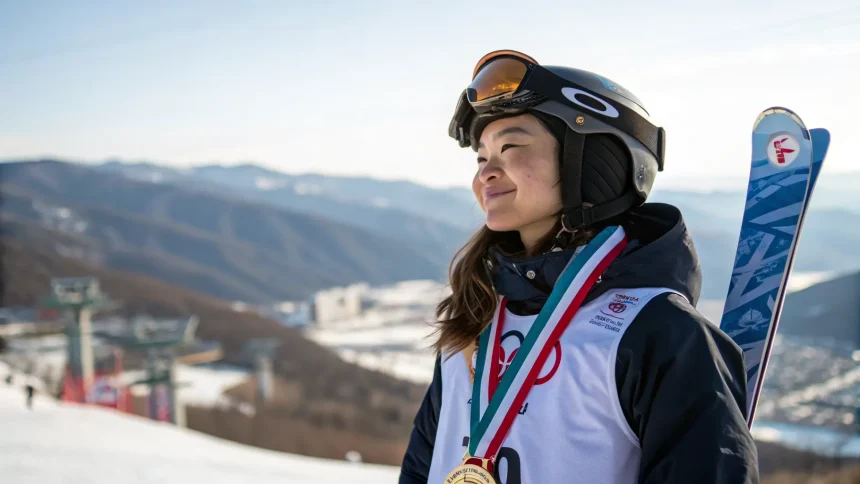
After defending her title in the women’s halfpipe, freestyle skiing star Eileen Gu used her moment on the podium to make a broader point about sport and identity. Addressing the spotlight that follows her every run, she said Olympic success is not tied to being male or female. Her message came as she celebrated another win and pushed back on the idea that greatness in sport should be filtered through gender.
Gu, who rose to global fame during the last Winter Olympics, has long been asked to speak for more than her medal count. This time, she kept it simple. The result was a clear statement at a time when conversations about gender equity in sports continue to evolve.
Context: A Champion With a Bigger Message
Gu’s comments land in a sport where style, difficulty, and fearlessness define the outcome. Halfpipe skiing rewards execution, not identity. Her reminder that performance stands on its own echoes a wider push in global sport to measure athletes by skill and results.
The International Olympic Committee has moved to balance participation across genders over recent Games. Women made up close to half of competitors at recent Olympics, with organizers aiming for parity. That change mirrors what fans see on snow and ice: deep fields, higher trick difficulty, and closer margins between podium runs.
Gu’s profile brings extra weight to the conversation. She won multiple medals at the last Winter Olympics, including gold, and has since remained one of the most visible athletes in action sports. That visibility often pulls her into debates that stretch well past the halfpipe walls.
What She Said and Why It Matters
“Olympic success has nothing to do with being a man or a woman.”
That line was brief, but it cut straight to the argument. In a judged sport, the best run wins. Spin counts, grab security, amplitude, and clean landings are what separate first from fourth. Gu’s statement suggests that dragging gender into the result sheet distracts from the hard math of performance.
For many athletes, this push is about more than dignity. It is about how their work is covered, sponsored, and rewarded. When success is framed as a curiosity because it comes from a woman, it can distort public expectations and limit investment. Gu’s stance asks for the simplest standard: fair evaluation of skill.
Progress and Gaps in Alpine and Action Sports
Women’s participation in elite skiing and snowboarding has grown over the last two decades. Training resources have improved, and courses are more consistent between men’s and women’s events. Prize money gaps have narrowed at some competitions, though disparities still appear across circuits.
- Recent Olympics have approached gender balance in athlete participation.
- Women’s halfpipe fields now feature higher trick difficulty and deeper competition.
- Coverage and sponsorship still vary widely by event and market.
Gu’s voice adds momentum to calls for equal standards in media and marketing. If fans tune in for risk, precision, and creativity, then the product on screen already meets the mark. The message is simple: judge the run, not the athlete’s gender.
The Athlete’s Platform and Public Expectations
Gu is used to big stages and bigger expectations. She has managed commercial appeal alongside athletic ambition, a balancing act that few pull off while still progressing a sport. Her comment suggests she would rather let tricks on snow carry the conversation.
At the same time, athletes of her stature often shape how younger competitors see their careers. When she centers performance, it signals to the next wave that the path to success runs through training plans, not stereotypes. That cultural shift can be as valuable as any medal.
What Comes Next for the Sport
Halfpipe progression rarely slows. Judges reward difficulty and clean execution, which forces athletes to push amplitude and link more complex combinations. That arms race of skill is gender neutral by design. If organizers, sponsors, and broadcasters hold to that premise, the sport benefits.
Expect debate to continue around investment, media time, and equal treatment across tours. But Gu’s statement offers a clear filter for those choices: back the best performances and tell those stories straight.
Eileen Gu won again and then asked the audience to focus on the why behind wins. The takeaway is crisp. Skill decides podiums. The next test will be whether the rest of the sport, from coverage to contracts, consistently follows that logic. Keep an eye on upcoming major events, where the judging sheets will say what words sometimes do not—and where the strongest run should stand on its own.