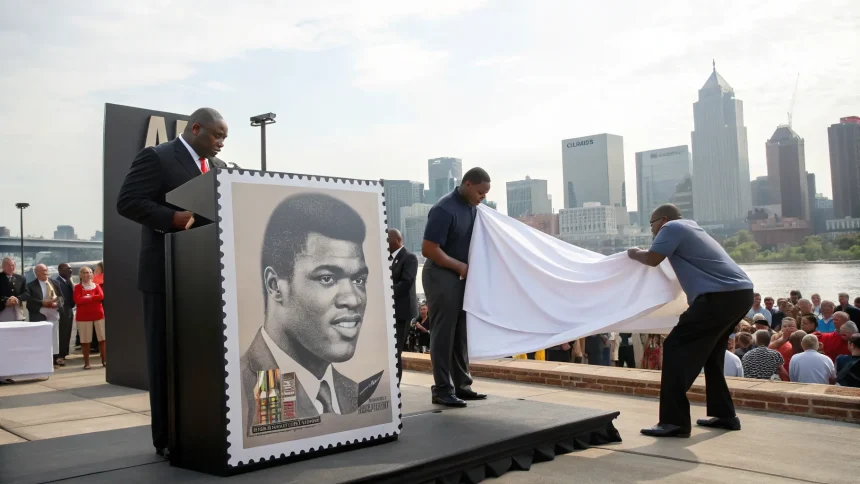
In a hometown salute to one of the century’s most famous athletes, postal officials unveiled a commemorative stamp honoring Muhammad Ali in Louisville, Kentucky. The unveiling celebrates the three-time heavyweight champion’s athletic brilliance and his lasting impact on culture, protest, and pride. It also signals how the nation continues to remember figures who shaped public life far beyond the ring.
A Hometown Tribute
Louisville is where Ali’s story started. Born Cassius Clay in 1942, he grew up on the city’s West End streets and learned to box at a local gym after his bicycle was stolen. From there, he rose to Olympic gold in 1960 and the world heavyweight title by 1964. The city later hosted his funeral in 2016, drawing mourners from across the world. A stamp in his honor, revealed here, ties that journey back to the place it began.
“Postal officials have unveiled a commemorative stamp of boxing legend Muhammad Ali in Louisville, Kentucky.”
The tribute reflects both sport and civic identity. It acknowledges a champion whose fights were as much about conscience as competition. It also reflects the way communities use public symbols to mark shared history.
Why Ali Still Matters
Ali’s record remains unmatched in storytelling force. He finished 56–5 with 37 knockouts and fought many of the era’s fiercest opponents. But it was his defiance outside the ring that made him a global figure. He refused induction into the U.S. Army during the Vietnam War, lost his boxing license, and was later vindicated by the Supreme Court in 1971. He changed his name, spoke openly about race and faith, and paid a price for it.
Those choices turned a sports idol into a moral voice. For supporters, the stand clarified what courage looks like. For critics, it tested ideas about patriotism and duty. The debates never fully ended, which is part of why Ali’s story keeps drawing new audiences. The stamp places that debate in wallets and on letters, a daily reminder that fame and principle can collide in public view.
Stamps as Cultural Memory
Commemorative stamps serve as miniature history lessons. They often honor artists, activists, scientists, and athletes who changed the country’s story. Sports figures on U.S. stamps have included stars whose legacies stretch far past scorecards.
- Jackie Robinson, whose career challenged segregation in Major League Baseball.
- Babe Ruth, an early icon of mass sports culture.
Placing Ali on a stamp continues that tradition. It treats boxing as more than a spectacle and recognizes his role as a cultural figure. Collectors often view such designs as artifacts that blend art, memory, and civics. Everyday mailers may just see a strong portrait and a name they know, which is part of the point. The stamp carries history into ordinary life.
Community and Industry Impact
For Louisville, the moment doubles as a civic brand boost. Ali’s name draws visitors to museums and memorials, and it anchors youth programs that encourage discipline and service. A national stamp announcement can bring fresh attention to those efforts and to the city’s tourism economy.
For the Postal Service, commemorative issues tend to engage collectors and casual buyers alike. Designs tied to widely admired figures often sell briskly. While each release is modest in price, the cumulative interest can be meaningful. More important is what the stamp signals about values: athletic excellence, social conscience, and the right to speak out.
What To Watch Next
Commemorative releases typically roll out through post offices and online storefronts after public ceremonies. Collectors often look for first-day cancellations and special keepsakes. Schools and libraries may build programming around the honoree, bringing a new generation into the story.
As the image circulates, expect renewed conversation about Ali’s example. His life invites questions about how athletes use their platforms, how communities remember conflict, and how a single figure can shape both sport and society. The stamp will not settle those debates. It will keep them visible.
The unveiling in Louisville ties past to present with a simple gesture and a small square of paper. It honors a fighter who shadowboxed with history and did not blink. For fans, it is a tribute. For the city, it is pride. For the nation, it is a reminder that courage can travel far—even on a letter.