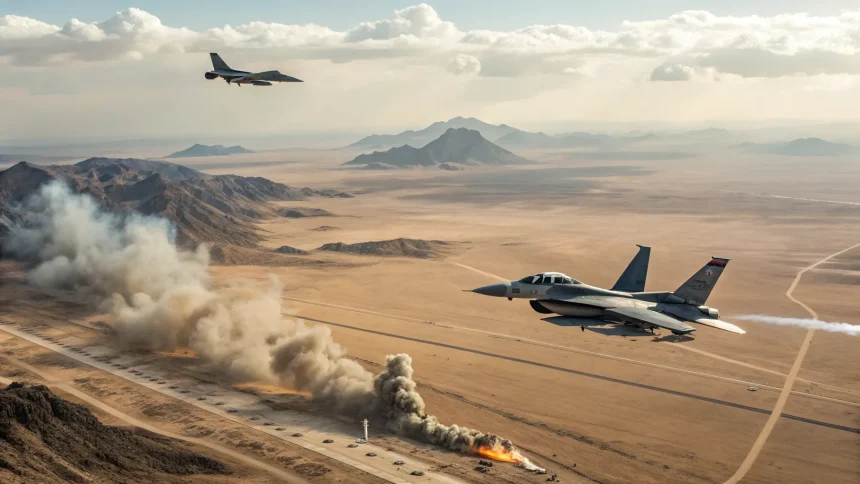
The United States carried out new strikes against Islamic State targets in Syria, escalating pressure after an ambush last month that killed two U.S. soldiers and an American interpreter. The action signals Washington’s intent to deter further attacks and maintain pressure on lingering ISIS networks in the country’s east and central deserts.
Officials described the operation as a response to the deadly attack on U.S. personnel. The strikes occurred in Syria, where a small U.S. presence supports local partners targeting ISIS cells. The move highlights the ongoing risks for American forces and contractors who back counterterrorism missions in the region.
“The U.S. has launched another round of strikes against the Islamic State in Syria. This follows last month’s ambush that killed two U.S. soldiers and an American civilian interpreter.”
Background: A Long War Against ISIS
The U.S.-led campaign against ISIS began in 2014 after the group seized large areas in Iraq and Syria. Territorial control has since collapsed, but ISIS remains active as an insurgency. Cells operate in Syria’s remote areas, staging ambushes, bombings, and attacks on security posts and patrols.
American forces in Syria work with local partners to find and disrupt these cells. Operations often focus on logistics hubs, weapons caches, and senior facilitators. The mission is framed as preventing a revival of the group’s capabilities.
Coalition activity has slowed compared to the peak years of the war. Yet sporadic attacks continue. Last month’s ambush underscores how ISIS strikes can still be lethal even as the group lacks formal control of towns or cities.
The Latest Strikes: Aims and Risks
Washington’s stated goal is to prevent further attacks on American personnel and partners. By hitting ISIS sites linked to planning or logistics, the U.S. seeks to deny the group safe havens. It also signals that killings of U.S. personnel will draw a rapid response.
There are risks. Strikes in Syria require careful planning due to crowded airspace and the presence of Syrian, Russian, and Iranian-backed forces. Deconfliction lines reduce miscalculation, but incidents can still occur. Civilian safety remains a concern in urban and semi-urban areas.
Analysts say ISIS has adapted to pressure by dispersing units and relying on local informant networks. That makes intelligence collection vital and time-sensitive. It also means follow-on raids and airstrikes are likely when credible targets emerge.
Families Mourn, Policy Debates Intensify
The deaths of two U.S. soldiers and an American interpreter have renewed debate over the mission. Supporters argue the presence prevents ISIS from regrouping and protects allies who fought the group on the ground. Critics question the duration and scope of deployments with no clear end date.
Legal authority for action is drawn from long-standing authorizations for use of force. Successive administrations have relied on them to target ISIS leaders and operatives. Lawmakers have urged regular updates on objectives and metrics to judge progress.
Local partners in Syria, including security units that hunt ISIS cells, depend on U.S. training, gear, and air support. If that support recedes, ISIS could find breathing room. If it grows, the risk to U.S. personnel may rise.
What We Know So Far
- U.S. forces launched new strikes against ISIS targets in Syria.
- The action follows an ambush that killed two U.S. soldiers and an American interpreter.
- Officials say the goal is to deter further attacks and disrupt ISIS cells.
What Comes Next
Expect more targeted operations in the near term. ISIS cells tend to probe for weak points after a high-profile attack. U.S. officials are likely to prioritize force protection, route security, and rapid strike packages for time-sensitive targets.
Regional dynamics could shape the tempo. Any flare-up involving Syrian regime forces, Russian aircraft, or Iranian-backed militias can complicate planning. Coordination with local partners will be key to limiting gaps that ISIS could exploit.
The central question remains how to keep pressure on ISIS without widening the mission. For now, Washington is signaling resolve while trying to keep the focus narrow: deny ISIS space, protect U.S. personnel, and support partners on the ground.
The latest strikes reinforce that mission. They also show the costs are real. The deaths last month will weigh on decision-makers as they balance risk, strategy, and the need to prevent an ISIS resurgence.