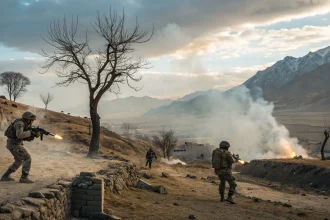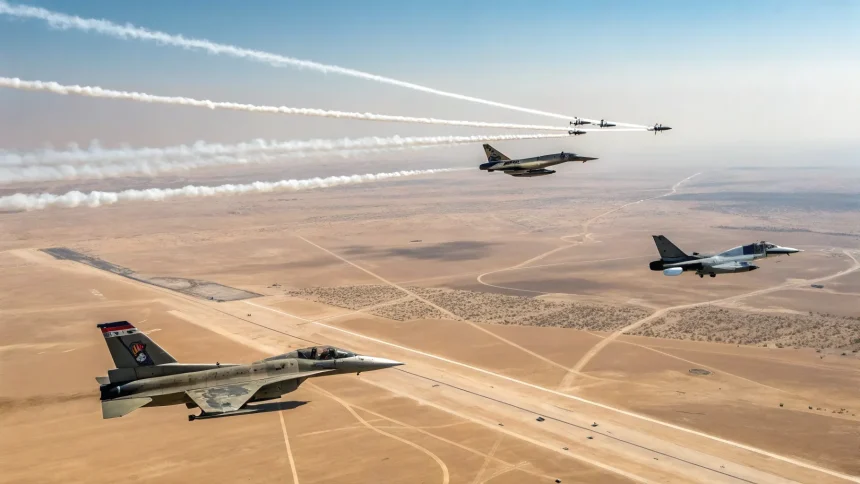
Jordan said its air force joined United States strikes on Islamic State targets in Syria on Saturday, days after three U.S. citizens were killed in a separate attack earlier this month. The action signals a tighter military alignment with Washington and a renewed push against militant networks along Jordan’s northern frontier.
The strikes hit sites in Syria linked to Islamic State, according to Jordanian and U.S. accounts. Officials framed the operation as part of a broader effort to deter cross-border threats and prevent militant regrouping.
“Jordan confirmed Saturday that its air force took part in strikes launched by the United States on Islamic State group targets in Syria in retaliation for the killing of three U.S. citizens earlier this month.”
Why Jordan Acted Now
Jordan has faced steady pressure from porous borders with Syria and Iraq since the rise of ISIS in 2014. While the group lost its territory years ago, sleeper cells and trafficking routes remain a concern. Amman has also confronted drug smuggling and armed infiltration from southern Syria, prompting periodic airstrikes against threats near the border.
The deaths of three U.S. citizens this month gave fresh urgency to joint operations. Jordan hosts U.S. troops and relies on close security ties with Washington. Supporting the strikes signals that Jordan wants to deter attacks that could spill into the kingdom or target its partners.
Jordan has long been part of the U.S.-led coalition against ISIS. The country stepped up its campaign after the 2015 killing of Jordanian pilot Muath al-Kasasbeh by ISIS, an event that hardened public support for confronting the group.
What the Strikes Targeted
Officials said the operation focused on ISIS-linked infrastructure in Syria. Those sites are often used for logistics, training, and planning. Analysts say such strikes can disrupt networks but rarely end the threat by themselves.
Military planners typically seek to degrade safe houses, weapons depots, and command nodes. The aim is to limit the group’s reach and deny freedom of movement near the border.
- Targets in Syria tied to ISIS operations
- Purpose: Disrupt planning and logistics
- Goal: Reduce cross-border threats to Jordan and U.S. personnel
Regional Risks and Response
The operation comes amid persistent instability in Syria, where government forces, opposition groups, and various militias operate in close quarters. Strikes risk blowback if militants disperse into civilian areas or retaliate with asymmetric attacks.
Jordanian officials have argued that early, precise action reduces those risks. They say cross-border strikes help prevent attacks inside the kingdom, which has faced several plots in recent years.
Humanitarian groups warn that escalations in Syria can harm civilians already living with limited aid and damaged infrastructure. They urge strict targeting and post-strike assessments to minimize harm.
What This Means for the Coalition
Jordan’s participation highlights the enduring role of regional partners in coalition efforts. While the United States brings intelligence, surveillance, and precision strike assets, local allies provide basing, airspace access, and on-the-ground knowledge of smuggling routes and militant movement.
Security experts say Jordan’s involvement could encourage other partners to share more intelligence or conduct joint operations when threats spike. They also caution that sustained pressure is needed, as ISIS cells tend to regroup when monitoring eases.
Domestic Considerations in Jordan
Amman must balance security needs with public opinion. Many Jordanians support action against ISIS but are wary of being pulled deeper into Syria’s conflict. The government has emphasized that its strikes focus on immediate threats and are coordinated with allies.
Officials also stress that protecting the border is a top priority. Smuggling has increased in recent years, with weapons and narcotics flowing south. Air operations are one part of a wider strategy that includes ground patrols, expanded surveillance, and cooperation with partners.
What to Watch Next
Key questions include whether ISIS-linked cells attempt retaliation, and if further joint operations follow. Observers will watch for changes in smuggling activity and militant movement near the Jordan-Syria border.
U.S. officials are likely to press for continued coalition pressure if threats persist. Jordan will weigh each step against the risk of escalation and domestic concerns.
The latest strikes show that both countries want to deter attacks and keep militants from rebuilding capacity. The approach pairs targeted action with intelligence sharing and border defense. The next weeks will show whether that pressure blunts the threat or triggers a new cycle of violence.
For now, Jordan’s decision underscores a clear message: attacks on U.S. citizens and regional partners will draw a coordinated response, and the fight against ISIS remnants remains unfinished.