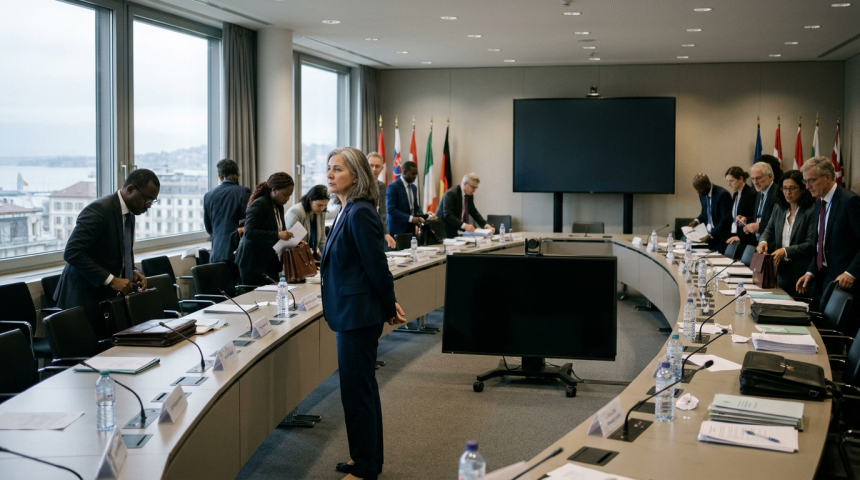
United Nations talks in Geneva have ended without binding rules for autonomous weapons, widening concern that military artificial intelligence is outpacing global diplomacy. Humanitarian groups warn that governments are losing time as weapons gain greater power to identify, track, and attack targets with less human control.
The failure leaves states without a shared legal standard for systems that can select or engage targets after activation. Existing international humanitarian law still applies. However, countries remain divided over whether those rules are enough for weapons guided by advanced software.
Negotiations Fail to Produce Binding Limits
Diplomats have discussed autonomous weapons for years through the United Nations framework in Geneva. The central dispute is whether nations should adopt a treaty, political commitments, or voluntary guidance.
Supporters of binding rules argue that machines should never make life-and-death decisions without meaningful human judgment. They seek clear limits on weapons that can operate unpredictably or target people without direct approval.
Other governments favor nonbinding measures. Some say current laws already cover new weapons. Others fear strict limits could block military research or place participating countries at a strategic disadvantage.
The latest failure shows that the gap between those positions remains wide. Because many UN arms talks rely on consensus, a small number of states can prevent an agreement from moving forward.
Human Control Sits at the Center
There is no single accepted definition of an autonomous weapon. That problem has complicated negotiations and left room for governments to describe similar systems in different ways.
Key questions include how much control a human must retain and how predictable a weapon must be. Negotiators must also decide who is responsible when an automated strike kills civilians or attacks the wrong target.
Humanitarian groups say military AI is “advancing far faster than diplomacy.” Their concern is not limited to fully independent machines. Software already supports surveillance, target recognition, threat assessment, and battlefield decisions.
- Campaigners seek firm human control over attack decisions.
- Some states support legal bans and restrictions.
- Others prefer voluntary standards or existing law.
- Accountability for errors remains unresolved.
Military AI Raises Legal and Civilian Risks
Automated systems may process large amounts of information faster than human operators. Militaries argue that this speed could improve responses and reduce some forms of human error.
Yet speed can also shorten the time available to verify a target or stop an attack. AI systems may misread unfamiliar settings, rely on flawed data, or behave differently under battlefield conditions.
These risks are especially serious in populated areas. A system trained to recognize military vehicles, weapons, or human behavior could produce false matches. Civilians may have little chance to understand or challenge an automated decision.
Accountability presents another problem. Responsibility could be spread among commanders, operators, weapons makers, software developers, and political leaders. Humanitarian advocates argue that unclear responsibility weakens both deterrence and justice.
Pressure Builds Outside the UN Process
Without a global treaty, countries may develop national rules or regional agreements. Coalitions of willing states could also pursue limits outside the consensus-based UN forum, following paths used in earlier efforts involving land mines and cluster munitions.
Such action could establish norms, but uneven participation would limit its reach. Major military powers may continue investing in autonomous capabilities while rejecting restrictions they view as too broad.
The Geneva outcome does not end diplomacy, but it increases pressure on governments to define acceptable human control. Future talks will need to address definitions, accountability, testing, and protections for civilians.
The main test will be whether states can turn broad concern into enforceable rules before battlefield use becomes widespread. Without faster action, technical decisions made by militaries and weapons developers may set the standards that diplomats have failed to agree.