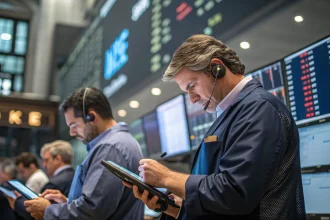
Anthropic’s reported record initial public offering on Nasdaq drew scrutiny from FOX Business host Charles Payne, who examined the deal on “Making Money.” The listing places the artificial intelligence company under the sharper demands of public markets.
The event could affect how investors value AI developers and their costly growth plans. However, key terms, including the offering size, share price, and first-day performance, were not disclosed in the available account.
Public Markets Test the AI Investment Case
An initial public offering allows a private company to sell shares to public investors. It can raise money for expansion while giving employees and earlier investors a path to sell holdings.
Public ownership also brings stricter financial reporting and closer review. Quarterly results can expose the gap between rapid sales growth and the high cost of developing advanced AI systems.
Payne’s attention to the listing reflects its wider importance for technology markets. A record transaction could set a reference point for other private AI companies considering public offerings.
Investors will likely examine several central issues:
- Revenue growth and the reliability of customer demand
- Computing costs and the path to sustained profits
- Dependence on major technology or cloud partners
- Competition, regulation, safety, and legal exposure
Anthropic Faces High Expectations
Anthropic develops Claude, an AI assistant designed to generate text, analyze information, and support workplace tasks. Its position in generative AI places it against other well-funded model developers.
That market has attracted large investments because businesses see potential gains in research, software development, and customer service. Yet advanced models require expensive computing capacity, skilled workers, and constant testing.
A large IPO valuation can help a company finance those needs. It can also create pressure to meet aggressive forecasts. If growth slows or costs remain elevated, public investors may question the price paid for future earnings.
The absence of detailed financial figures limits any firm judgment about Anthropic’s valuation. A record label alone does not show whether the shares offer a reasonable balance of risk and potential return.
What the Listing Could Mean for Nasdaq
Nasdaq has long served as a major exchange for technology companies. A successful Anthropic debut could encourage other venture-backed firms to test investor demand, especially after periods when new listings were less active.
The deal may also give markets a clearer way to value companies focused mainly on generative AI. Until now, much public exposure to the sector has come through larger technology groups with many business lines.
Still, one strong debut would not guarantee similar results for later issuers. Investors will compare each company’s sales, losses, customer base, governance, and access to computing resources.
Attention Shifts to Financial Results
After the initial trading response, the focus will move to execution. Anthropic will need to show that customer use can produce durable revenue while operating costs become more manageable.
Future disclosures should clarify the company’s cash needs, partner relationships, and profit outlook. They may also reveal how management plans to address safety rules and growing government oversight.
Payne’s analysis highlights the central question surrounding the offering: whether enthusiasm for AI can translate into lasting shareholder value. Anthropic’s first public earnings reports will provide a more useful test than its opening-day valuation alone.