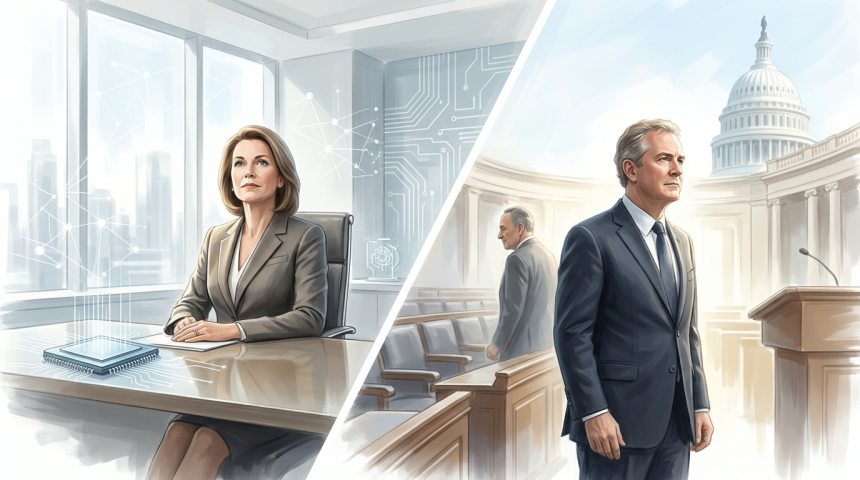
Two major leadership challenges are taking shape across corporate America and Washington. Nvidia’s finance chief has become interim CEO after Jensen Huang stepped down, while Sen. Chris Van Hollen plans to challenge Chuck Schumer for Senate majority leader.
The developments place succession questions at the center of a leading technology company and the Democratic Party. Neither announcement included detailed reasons for the proposed changes or a timeline for permanent decisions.
Nvidia Begins a New Leadership Chapter
Huang’s departure marks a major shift for Nvidia. He co-founded the company in 1993 and led its growth from a graphics-chip maker into a key supplier of computing systems used for artificial intelligence.
Nvidia’s chief financial officer will serve as interim CEO. The executive’s name was not provided in the announcement. That temporary appointment may help preserve stability while the board considers a permanent successor.
A finance chief can bring close knowledge of company spending, revenue and investor expectations. However, the CEO role also requires decisions about product strategy, research and global competition.
Investors are likely to seek answers on several issues:
- How long the interim period will last
- Whether Nvidia will consider internal and external candidates
- How the change could affect AI chip development
- Whether Huang will retain another role at the company
Huang has been closely tied to Nvidia’s public identity and technical direction. His exit from the CEO position could therefore affect employee confidence and relationships with customers, suppliers and shareholders.
The company also faces intense competition in advanced computing. Large technology companies are designing their own chips, while established semiconductor rivals are investing heavily in AI products.
Van Hollen Targets Senate Leadership
In Washington, Van Hollen’s planned challenge signals possible unrest among Senate Democrats. Schumer has led the Senate Democratic caucus since 2017 and has served in both majority and minority leadership roles.
Van Hollen, a Maryland Democrat, previously served in the House before entering the Senate in 2017. A leadership bid would require him to win support from Democratic senators through an internal party vote.
Van Hollen said he would challenge Schumer for the position of majority leader.
The announcement did not explain Van Hollen’s case against Schumer. It also did not identify senators supporting the effort. Those details will determine whether the bid becomes a serious contest or mainly expresses concern about the party’s direction.
The title of majority leader depends on control of the Senate. Even if Democrats select a leader, that person can hold the majority post only when the party controls enough seats to organize the chamber.
Two Succession Tests With Wider Stakes
Nvidia’s board and Senate Democrats now face different versions of the same problem. Each must decide whether continuity or a change in direction offers the stronger path.
For Nvidia, the next signals will include board statements, regulatory filings and details about Huang’s future. Markets will also watch the company’s financial guidance and product schedule.
For Democrats, attention will shift to endorsements, internal caucus discussions and the Senate election outlook. Van Hollen must show that colleagues want a leadership change and believe he can unite the caucus.
Both developments remain unsettled. The choice of Nvidia’s permanent CEO could shape competition across the AI industry. The Senate contest could influence Democratic strategy, legislative priorities and the party’s public message.