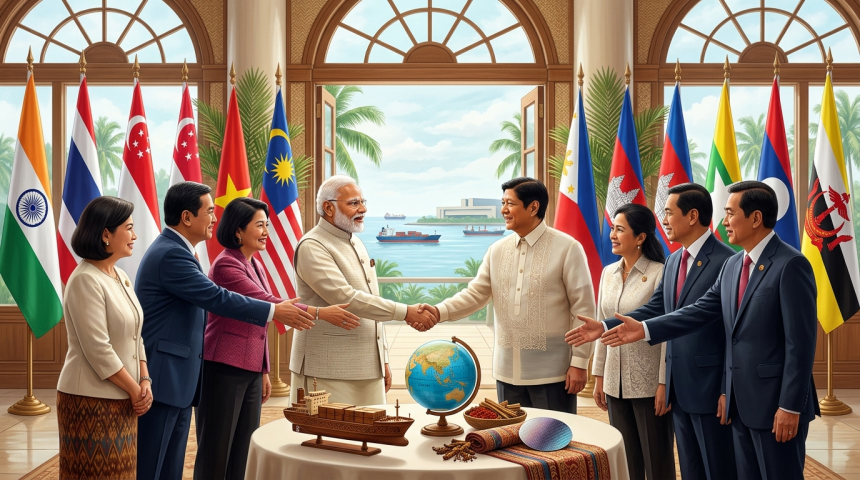
India and Southeast Asian nations are seeking closer economic, maritime and technology ties as bilateral trade reaches $128.37 billion. Prime Minister Narendra Modi is advancing that agenda during a visit to the Philippines for two major regional summits.
Modi is attending the 23rd ASEAN-India Summit and the 21st East Asia Summit. The meetings are focused on strengthening the Comprehensive Strategic Partnership between India and the Association of Southeast Asian Nations.
Trade and Investment Anchor the Relationship
India-ASEAN bilateral trade reached $128.37 billion in the 2025-26 financial year. The figure shows the economic weight of a relationship that connects India with one of Asia’s largest regional groups.
Reported investments from ASEAN stood at $196.96 billion. The investment figure is larger than annual trade, although the period and measurement used for that total were not specified.
Those numbers give both sides a strong reason to reduce commercial barriers and improve market access. They also place pressure on leaders to turn summit commitments into measurable gains for businesses and workers.
ASEAN includes 10 Southeast Asian countries. Its members sit along important shipping routes and link the Indian and Pacific oceans. That position makes the group important for trade, supply chains and regional security.
India Places ASEAN at Center of Eastern Policy
Modi described ASEAN as central to India’s Act East Policy and its Indo-Pacific vision. The policy seeks stronger political, economic and security relations with countries to India’s east.
ASEAN remains central to India’s Act East Policy and its Indo-Pacific vision, according to Modi’s message during the regional engagement.
The Philippines visit gives India an opportunity to discuss regional concerns with several governments at once. It also allows New Delhi to reinforce its support for ASEAN-led forums during a period of strategic competition across Asia.
The East Asia Summit brings together ASEAN members and major regional partners. Its agenda typically covers economic cooperation, maritime stability and shared security concerns. India’s participation reflects its effort to maintain broad ties without relying on a single regional partner.
Maritime and Technology Cooperation Gain Attention
Maritime cooperation is a key part of the talks because much of Asia’s trade moves by sea. Stable shipping routes affect energy supplies, manufacturing schedules and consumer prices across the region.
India and ASEAN are also placing more attention on technology. Cooperation could include digital trade, communications systems and stronger links between technology businesses. However, the available details do not identify specific projects, funding levels or deadlines.
The summit agenda centers on three areas:
- Expanding trade and investment links.
- Supporting maritime cooperation and secure shipping routes.
- Building closer technology partnerships.
The broad agenda offers room for progress, but it also presents challenges. ASEAN members have different economic priorities and levels of development. Agreements must account for those differences while producing practical benefits across the group.
Attention Turns to Measurable Results
The scale of trade and investment suggests that India-ASEAN relations already have substantial economic value. The next test is whether leaders can improve access to markets, support investment and create dependable rules for new areas of cooperation.
Future announcements on maritime programs, technology projects and commercial agreements will show how far the partnership advances. Clear timelines and published targets would also help governments and companies measure progress.
Modi’s Philippines visit places ASEAN near the center of India’s regional strategy. With billions of dollars in trade and investment involved, the summit outcomes could influence supply chains, security planning and economic ties across the Indo-Pacific.