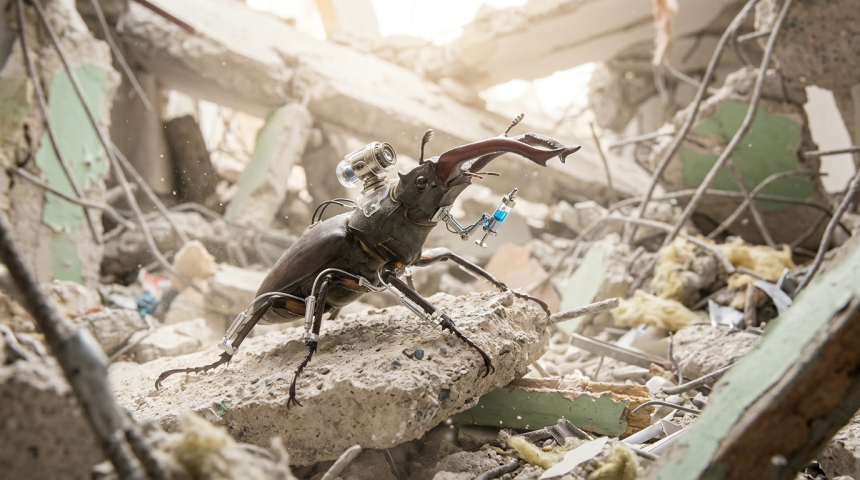
Biorobotics engineers have equipped cyborg insects with cameras and tiny medical injectors, creating potential first responders for collapsed buildings and caves. The experimental systems are designed to locate trapped people and deliver urgent treatment where human rescuers and larger robots cannot safely travel.
Details about the research team, location, testing schedule, and insect species were not disclosed. The project nevertheless points to a new direction in disaster response: pairing the mobility of living insects with compact electronic and medical devices.
Reaching Spaces That Robots Cannot
Collapsed structures present severe risks for rescue crews. Rubble can shift without warning, while dust, darkness, and narrow gaps can block access. Cave emergencies pose similar problems, including tight passages and limited communication.
Small insects are well suited to moving through such settings. They can crawl across uneven surfaces and squeeze through openings that wheeled or tracked machines may be unable to enter.
The engineers describe cyborg insects fitted with two key tools:
- Cameras that could provide images from confined or unstable areas.
- Miniature injectors intended to deliver emergency medical aid.
That combination could allow a device to perform two tasks during one mission. It could help rescuers find a survivor, then provide limited care before a medical team reaches the person.
From Detection to Immediate Treatment
Search technology often focuses on locating survivors through cameras, microphones, heat sensors, or radar. Adding an injector shifts the role of a cyborg insect from observation to direct assistance.
The insects are intended “to deliver emergency aid to people trapped in collapsed buildings or caves.”
In practice, any medical use would require strict controls. A system would need to identify the correct person, carry an appropriate substance, and administer an accurate dose. Medical teams would also need reliable information about allergies, injuries, and the survivor’s condition.
The injector may therefore be most useful for carefully selected treatments under remote professional supervision. The available information does not identify which medicines could be carried or whether injections have been tested on people.
Safety and Reliability Remain Key Tests
Cameras could give rescue coordinators useful visual information, but disaster sites can disrupt signals. Thick rock, concrete, metal, and soil may interfere with wireless links. Engineers would need dependable communication, navigation, and power systems.
Animal welfare is another concern. Turning living insects into mobile platforms raises questions about how they are controlled and whether attached equipment harms them. Emergency agencies would also need rules for handling devices that carry needles or medication.
Rescuers are unlikely to treat cyborg insects as replacements for trained teams. Instead, the systems could serve as early scouts, reducing uncertainty before people enter unstable areas. Images from several insects might also help teams map safe routes and identify hazards.
A Promising Tool With Unanswered Questions
The concept could expand the options available during the first critical hours after a collapse or underground accident. Its value will depend on field testing under dust, darkness, moisture, impact, and communication loss.
Future assessments should examine navigation accuracy, image quality, medical dosing, survivor safety, and recovery of the insects after deployment. Regulators and emergency medical specialists would also need to define who may authorize treatment.
Cyborg insects may offer a practical way to reach places inaccessible to people and conventional machines. For now, the central question is whether engineers can turn a striking laboratory concept into a safe, controlled, and dependable rescue tool.