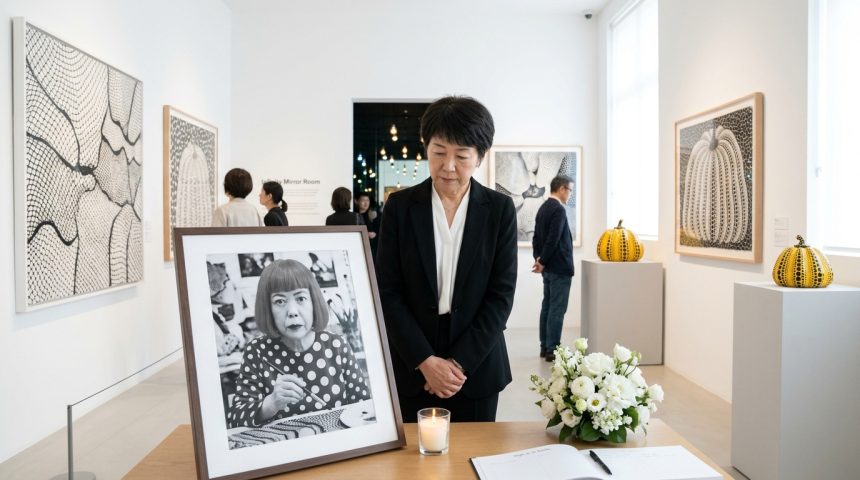
Yayoi Kusama, the pioneering Japanese artist who turned polka dots and mirrored rooms into a global visual language, has died.
Kusama’s paintings, sculptures, and museum installations reached audiences across the world. Her death closes a singular career that joined avant-garde experimentation with broad public appeal.
Details about the timing, location, and cause of her death were not immediately provided. Her legacy, however, is already visible in museums, public artworks, and the countless photographs taken inside her installations.
Polka Dots Became a Global Signature
Kusama was best known for covering objects and spaces with repeated dots. She applied them to canvases, pumpkins, furniture, clothing, rooms, and large sculptures.
The motif was more than an easy-to-spot trademark. Repetition allowed Kusama to blur the line between a single object and the space around it.
Her work often made viewers feel surrounded or absorbed. That effect became especially clear in her Infinity Mirror Rooms, where mirrors and lights created the impression of endless space.
Those rooms became major museum attractions. Visitors often waited in long lines for brief, timed entries. The experience proved that difficult ideas about perception and identity could also draw a mass audience.
Kusama “splashed her signature polka dots on paintings, sculptures and museum installations around the world.”
From Japan to New York and Back
Born in Matsumoto, Japan, Kusama developed an interest in art at a young age. She later moved to the United States and entered New York’s experimental art scene in the late 1950s.
During the 1960s, she produced paintings, performances, installations, and public events. Her work addressed infinity, the body, sexuality, war, and the loss of individual identity.
Kusama worked near artists who became central figures in postwar American art. Yet recognition was uneven, reflecting the obstacles faced by a Japanese woman working in a male-led art market.
She returned to Japan in the 1970s. Over time, museums and critics reassessed her work, leading to major exhibitions and a sharp rise in international attention.
Art That Thrived in the Camera Age
Kusama’s late-career popularity grew alongside social media. Her installations were highly photogenic, but their appeal was not limited to a good picture.
They offered a rare mix of simple forms and unsettling ideas. A field of dots could look playful, then suggest disappearance, obsession, or endless repetition.
Her most familiar subjects included:
- Polka-dotted pumpkins and flowers
- Mirrored rooms filled with lights
- Large paintings built from repeated marks
- Immersive spaces covering walls, floors, and objects
This accessibility helped Kusama cross lines between fine art and popular culture. It also sparked debate about spectacle, crowds, and whether photographs sometimes overshadowed the work itself.
A Lasting Influence on Museums
Kusama helped reshape expectations for museum exhibitions. Her installations invited visitors to enter the artwork rather than simply stand before it.
That model has influenced contemporary exhibition design, especially shows built around participation and immersion. Few artists linked personal imagery, serious themes, and public enthusiasm so effectively.
Questions about new exhibitions, conservation, and control of her artistic estate will follow. For museums, the immediate task will be preserving works that depend on light, mirrors, scale, and carefully managed visitor access.
Kusama leaves an unmistakable body of work. Her dots made rooms feel infinite, pumpkins feel monumental, and repetition feel personal. The crowds may thin, but those patterns will keep spreading.