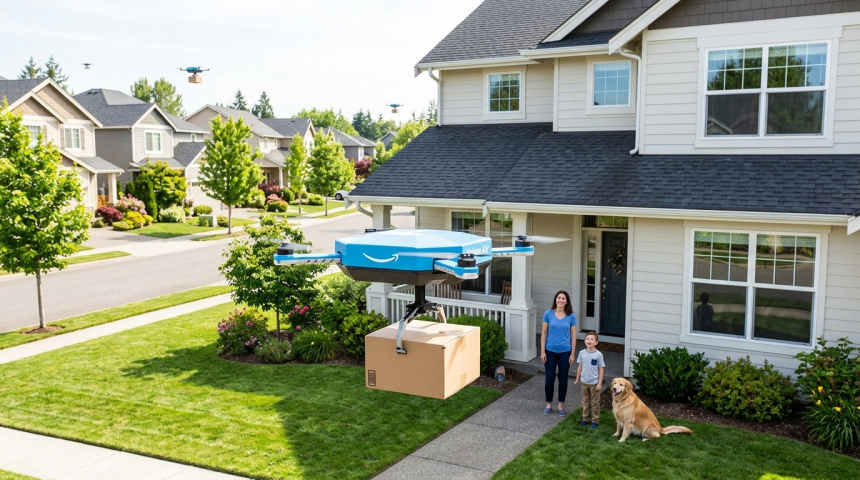
Amazon plans to expand its Prime Air drone delivery service to nearly 500 U.S. cities and towns by the end of this year. The move would bring a long-delayed project closer to the broad reach envisioned by founder Jeff Bezos more than a decade ago.
The planned rollout marks a major increase in the program’s geographic reach. It also tests whether drone delivery can become a practical part of Amazon’s logistics network rather than a limited service in selected markets.
A Vision Announced in 2013
Bezos introduced Prime Air during an appearance on CBS’s “60 Minutes” in December 2013. The announcement presented small aircraft as a possible way to carry eligible orders directly to customers.
Bezos estimated that the service was “at least four or five years away.”
That forecast suggested a possible launch between 2017 and 2018. Instead, the effort took much longer to reach the scale now planned.
The gap reflects the challenge of moving autonomous aircraft from demonstrations into regular commercial use. Drone delivery requires reliable equipment, suitable operating locations and procedures designed to protect customers and nearby communities.
Expansion Raises the Stakes
Reaching nearly 500 cities and towns would expose Prime Air to a wider mix of conditions. Dense suburbs, smaller communities, varied weather and different property layouts can each affect operations.
The expansion could also give Amazon more information about customer demand. A larger service area may show whether shoppers value rapid aerial delivery enough to make it a regular option.
Key issues to watch include:
- How many households can use the service within each community
- Which products qualify for drone delivery
- How Amazon manages noise, privacy and safety concerns
- Whether the service can operate reliably in poor weather
- How drone costs compare with vans and other delivery methods
The figure of nearly 500 communities is significant, but it does not reveal the number of customers covered. A service may operate in a city while remaining available only within designated delivery zones.
Potential Gains and Public Concerns
For Amazon, drones could shorten delivery times for small, urgent orders. They may also reduce the need for some short vehicle trips, especially when a distribution site is near a customer.
Yet rapid delivery must be weighed against public concerns. Residents may question aircraft noise, overhead traffic and the collection of visual or location data. Local acceptance could differ sharply from one community to another.
Safety will remain central to the program’s credibility. A wider rollout means more flights and more contact with homes, roads, people and other aircraft. Any serious incident could slow adoption and invite closer scrutiny.
Traditional delivery will remain necessary for large packages, longer routes and locations unsuitable for drones. Prime Air is therefore more likely to support Amazon’s existing network than replace trucks and vans.
A Test of Commercial Scale
The next stage will measure more than technical performance. Amazon must show that Prime Air can deliver packages consistently, at a workable cost and with community support.
The long period since Bezos’s 2013 announcement offers a caution against treating ambitious timelines as firm outcomes. It also shows how difficult it is to introduce automated aircraft into daily public life.
By the end of the year, attention will focus on whether Amazon reaches its target of nearly 500 cities and towns. Flight volume, customer access, safety records and local response will offer a clearer measure of progress than geographic reach alone.
If the expansion works as planned, Prime Air could become a more visible part of U.S. package delivery. If operational or public concerns persist, the program may remain a specialized option despite its larger footprint.