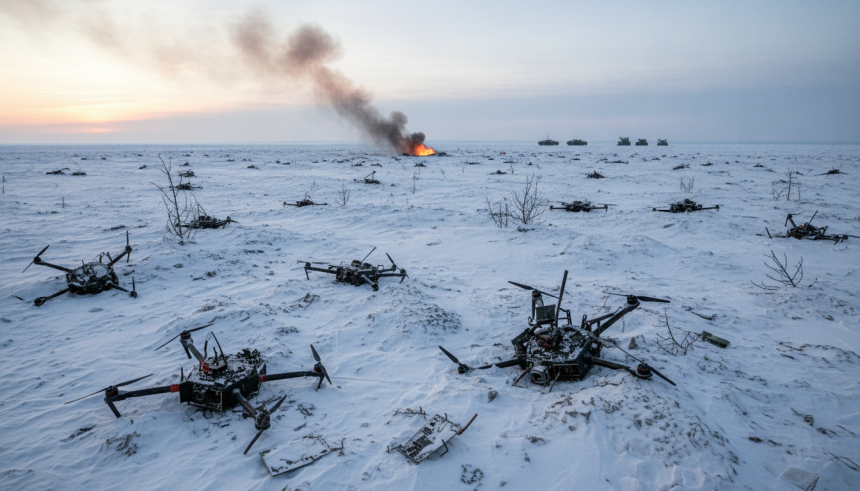
Russia said it shot down a large wave of Ukrainian drones overnight, a claim that points to the scale of the drone war now shaping the conflict. The Defense Ministry reported the incident on Tuesday, without naming specific regions. The announcement comes amid frequent cross-border strikes and growing use of low-cost unmanned systems by both sides.
The statement did not include details on damage or casualties. Independent verification was not available at the time of publication. Ukraine has used long-range drones to hit targets behind the front, including logistics and energy assets, while Russia has targeted Ukrainian cities and power infrastructure with missiles and drones.
What Russia Says Happened
In a short statement, Russia’s Defense Ministry said it intercepted a large number of drones launched from Ukraine. Officials described the overnight action as a mass attempt to breach air defenses.
“At least 320 Ukrainian drones” were downed overnight, the ministry said.
No video or imagery accompanied the claim. The ministry did not specify the types of drones or the interception methods used.
Verification and Competing Claims
Large drone tally claims have become common as both militaries fight for control of the airspace. Figures often vary by source and are hard to verify, especially within hours of an event. Ukraine rarely comments in detail on strikes inside Russia, citing operational security.
Analysts say numbers announced soon after incidents can change. Damage assessments and debris analysis usually take more time. Local reports, satellite imagery, and open-source footage often help clarify what occurred, but those were not available immediately.
Drone Warfare’s Growing Role
Drones now drive much of the battlefield tempo. They scout troop positions, guide artillery, and strike supply lines. They are cheaper than missiles and can be produced in high volumes. This has led to near-daily skirmishes in the air.
Russia has invested in layered air defense that includes radar, missiles, and electronic warfare. Ukraine mixes domestically built systems with modified commercial models, seeking to bypass or overwhelm those defenses. The result is a contest that blends quantity, range, and precision.
- Cheap drones can force costly interceptions.
- Mass launches test radar coverage and reaction time.
- Electronic warfare can disrupt or divert incoming drones.
Impact on Energy and Security
Long-range drone attacks often target fuel depots, airfields, and power sites. Disruptions at those locations can ripple through supply chains. Each successful strike can reduce movement of ammo, fuel, or reinforcements to the front.
For civilians, the main risk is debris from interceptions and secondary fires. Authorities in both countries have urged residents to heed air alerts. Insurance, shipping, and rail operations can also face interruptions after high-profile incidents.
If the reported number is accurate, it suggests Ukraine sought to saturate defenses. That approach can force Russia to expend missiles and deploy more jamming, raising costs. It can also reveal gaps in coverage that future raids might exploit.
Trends and What Comes Next
Mass drone sorties suggest a shift to attrition in the air. Each side tries to drain the other’s interceptors and reveal tactics. If this pattern holds, expect more night launches, mixed drone types, and efforts to confuse radar with decoys.
Production capacity is key. Ukraine has pushed to scale domestic output. Russia has expanded assembly lines and imported parts for its own fleets and defenses. Training and software updates are now as important as hardware.
Regional authorities and open-source investigators may release further evidence in the coming days. Satellite passes could show scorch marks or damaged sites, if any were hit. Official tallies from both sides will likely continue to differ.
The latest claim highlights a air war defined by volume and speed. The figure of at least 320 drones is striking, but proof and impact remain unclear. Watch for follow-up reports, local confirmations, and evidence from independent monitoring. The balance between cheap drones and costly defenses will shape operations, resource use, and risk to infrastructure in the weeks ahead.