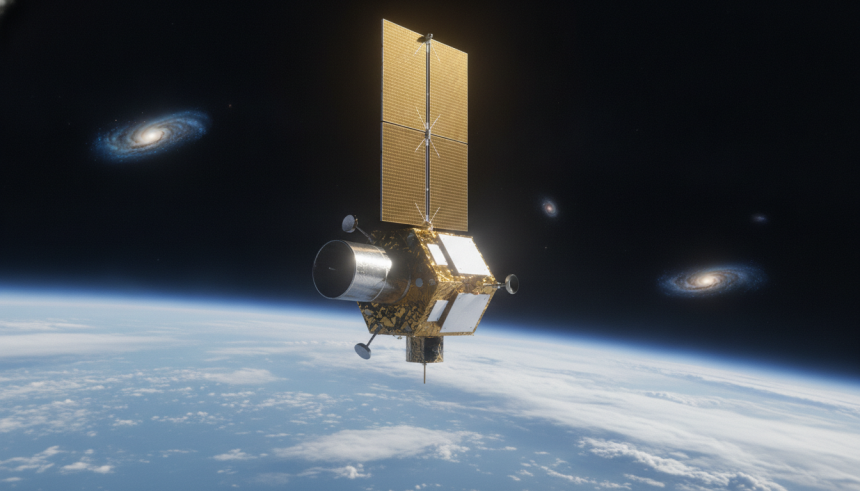
With a design life of two years, a small NASA satellite has quietly stayed on duty for more than two decades, changing how scientists study the most violent blasts in the cosmos. The Neil Gehrels Swift Observatory, launched in 2004 into low Earth orbit, continues to spot and track gamma-ray bursts, rapid flares of energy born from collapsing stars and merging neutron stars. Its long run highlights the staying power of well built space hardware and the value of steady investments in small missions.
NASA planned Swift for a short mission aimed at rapid detection and follow up of these fleeting events. The satellite was later renamed to honor astrophysicist Neil Gehrels. It remains a workhorse for astronomers who race to capture afterglows in X-ray, ultraviolet, and visible light within minutes of the first alert.
Launched in 2004, the Neil Gehrels Swift Observatory was supposed to last only two years, but it’s been operating for more than two decades.
Why a Two-Year Mission Became a Marathon
Short design lifetimes are common for smaller satellites. They help control cost and set realistic expectations for consumables and aging electronics. Swift’s extended run shows how margins in design, careful operations, and a bit of luck can stretch a mission far past its original plan.
NASA program documents describe Swift as a rapid-response observatory. It can pivot within minutes to capture fresh afterglows that fade quickly. That agility, combined with stable instruments, has kept the spacecraft relevant long after launch.
What Swift Sees and How It Works
Swift carries three co-aligned instruments that work together to find and study high-energy events in the sky:
- Burst Alert Telescope spots gamma-ray flashes and triggers fast slews.
- X-Ray Telescope images the afterglow and refines the position.
- Ultraviolet and Optical Telescope measures light at shorter wavelengths.
When a burst appears, the spacecraft sends alerts to the ground within seconds. Robotic and human observers then move larger telescopes to the target. This handoff has turned a once rare catch into a frequent and well characterized class of events.
Scientific Reach and Ripple Effects
Swift’s fast alerts have helped link short gamma-ray bursts to mergers of compact stars, a key clue that later aligned with gravitational wave detections. Long bursts have traced star formation in distant galaxies. The mission also contributes to studies of active black holes, tidal disruption events, and stellar flares, since its alert system flags many kinds of energetic transients.
Astronomers say the value comes from speed and reliability. Swift provides precise positions that can be shared widely in near real time. That coordination has seeded a global network of follow up, from small school observatories to giant facilities.
Engineering Lessons From Long Life
Keeping a satellite healthy for decades takes care and restraint. Operators manage pointing hardware, cycling patterns, and thermal loads to avoid wear. Software updates can work around aging components. The payoff is clear. Each extra year leverages sunk costs and adds fresh science without building a new spacecraft.
Swift’s longevity sits alongside other long lived missions such as Hubble and Chandra, though on a smaller budget. Together, they show that modest platforms can anchor big discoveries when they are steady and quick.
What Comes Next
New observatories focused on transients are coming online. Ground based surveys will scan the sky every few nights. Future X-ray and gamma-ray missions are in planning. Still, Swift’s fast alerts and coordinated follow up will remain valuable as long as the spacecraft stays healthy.
Mission managers typically evaluate status year by year. As parts age, some capabilities may narrow, but core functions often continue. That makes Swift an example for designing future small missions with flexible operations and team agility.
The satellite launched as a sprint, but it turned into a relay that keeps handing off fresh targets to the world. The lesson is simple. Build well, operate smart, and a two-year plan can age into a classic. For now, keep an eye on the alert stream. When the next burst hits, Swift is still likely to be first on scene.