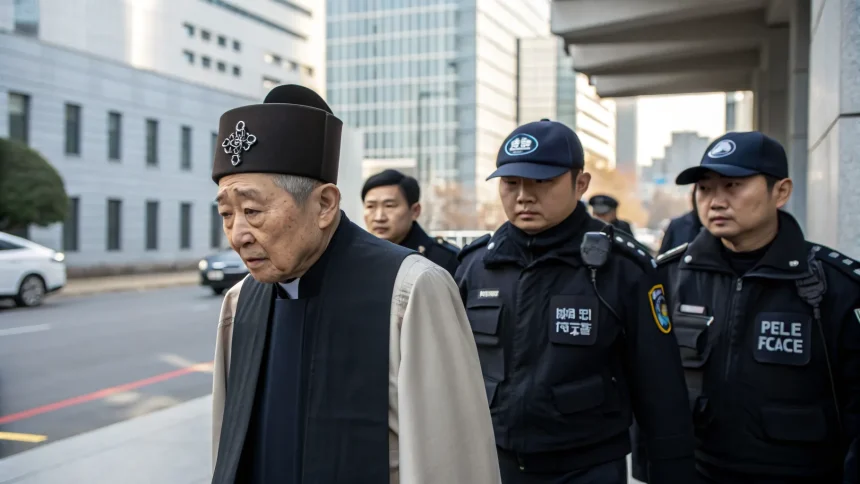
South Korean authorities arrested a 95-year-old leader of a secretive church as investigators widened a probe into alleged election interference tied to the conservative People Power Party. The arrest, confirmed this week in Seoul, centers on claims that the religious figure orchestrated large-scale recruitment of followers into the party to sway internal decisions and public votes.
Officials say the case touches on the country’s strict rules on political activity and could test how parties vet new members. It also revives long-running concerns over coordinated voting by religious groups and civic networks.
Allegations of Mass Recruitment
Authorities allege the church leader “illegally recruited thousands of followers into the conservative People Power Party to influence elections.”
Investigators have not publicly detailed the timeline or the exact contests at issue. The phrase “thousands of followers” signals a scale large enough to affect candidate selection, primaries, or local races if proven. The church has not been named by officials in available statements, and no trial date has been announced.
Election law in South Korea bars organized schemes that manipulate party membership lists or pressure voters. Prosecutors are looking at whether recruitment was coordinated, concealed, or involved inducements that would breach those laws. The leader, whose name was not released by authorities at the time of the arrest report, is expected to face questioning about how the network operated and who directed it.
Why This Matters Now
The People Power Party, often referred to as the main conservative party, holds significant sway in national and local politics. Any suggestion of engineered membership drives raises questions about internal party fairness and the integrity of candidate slates. Even without evidence of direct party involvement, mass sign-ups tied to a single organization can tilt outcomes in close races.
South Korea has a history of heated debates over the role of powerful social and religious groups in elections. Coordinated voting blocs can shape primaries, flood local party chapters, and influence turnout. Cases tied to organized recruitment have drawn scrutiny before, though few reach the scale alleged here.
Inside the Widening Probe
Authorities are expanding their inquiry to map the flow of instructions and money, if any, and to determine whether the operation crossed legal lines. They will also try to learn if other church officials or political intermediaries were involved.
- How membership forms were gathered and submitted
- Whether followers were pressured or promised benefits
- Which races or party decisions the effort targeted
Legal experts note that proving “illegal recruitment” often turns on evidence of coercion, concealment, or systematic deception. They also stress that the accused is presumed innocent until proven guilty in court.
Reactions and Risks
The case places new pressure on party gatekeeping. Parties rely on local chapters to vet new members, but large influxes can arrive quickly. Analysts say even legitimate outreach can blur lines when channeled through tightly run networks.
Civil society groups have argued for clearer auditing of bulk membership registrations. They favor better identity checks, waiting periods before members can vote in primaries, and stronger rules against coordinated sign-ups by single organizations.
For religious communities, the arrest could chill activity at the edge of politics. Many faith groups encourage civic engagement, which is legal. The line is crossed when organized efforts aim to distort internal party processes or violate campaign rules.
What Comes Next
Prosecutors are expected to seek more records from party offices and community organizers. Defense attorneys for the church leader will likely challenge the claims, arguing that members joined of their own free will and that no law was broken.
If charges move ahead, the court will examine whether the effort was coordinated, whether consent was informed and voluntary, and whether the intent was to influence specific elections. The outcome could set clearer limits on large-scale recruitment campaigns tied to any private organization.
The case will shape debate on how parties guard internal votes and how authorities police organized influence. Watch for signs of tighter party rules on bulk registrations, new guidance from election regulators, and whether the probe draws in additional figures. The arrest signals heightened scrutiny of networks that try to steer political outcomes from the shadows. The next phase—evidence presented in court—will show how far that scrutiny goes.