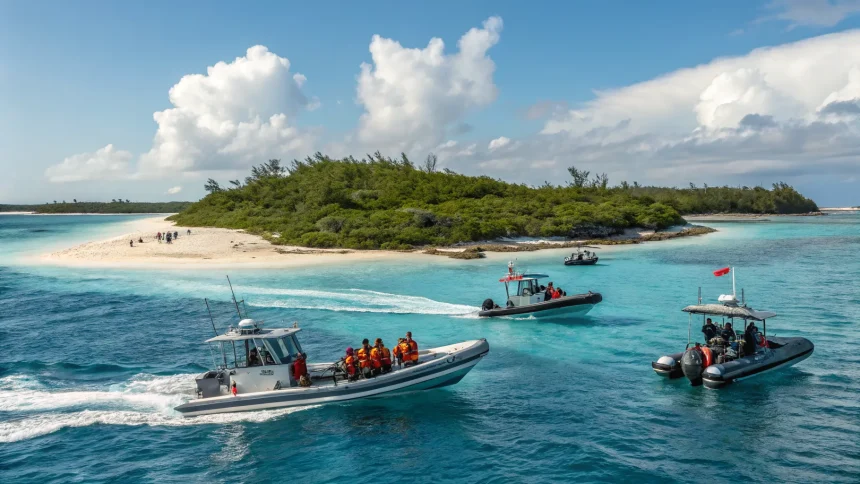
Authorities are searching near Elbow Cay after a woman went overboard during a short trip between two Abaco cays, prompting urgent questions about small-craft safety in busy island waters.
Officials said the woman, identified as Lynette Hooker, was traveling with her husband from Hope Town to Elbow Cay on Saturday when she fell into the water. The crossing is a familiar route for locals and visitors, often covered in minutes by small boats. What happened in those moments remains under review.
A Short Crossing With High Stakes
The narrow channels between Hope Town and Elbow Cay are popular and usually calm in fair weather. But even routine trips carry risks. Tides can run swift. Afternoon squalls can build fast. A distraction can become dangerous before anyone reaches for the throttle.
Mariners in the Abacos often describe the passage as quick but tricky. Sparse markers, shoals, and traffic can add stress, especially for light craft or renters unfamiliar with local routes.
What Authorities Have Confirmed
“Lynette Hooker was traveling with her husband from Hope Town to Elbow Cay on Saturday when she went overboard,” the authorities said.
Officials have not released details on sea conditions, the size of the vessel, or whether safety gear was in use. No timeline for updates was given. In similar incidents, local police, volunteer rescuers, and coastal units coordinate searches by boat and, when available, from the air.
Patterns in Maritime Incidents
Small-boat fall-overboard events tend to share familiar triggers. A sudden turn, a wake from a passing craft, or a slip near the gunwale can send a passenger into the water. In clear, warm seas, panic can be as dangerous as the fall itself.
While official statistics vary by jurisdiction and year, marine agencies consistently identify one factor as the strongest predictor of survival: wearing a life jacket. Another frequent lesson is speed. Quick recovery—by marking the spot, keeping visual contact, and executing a controlled return—can make the difference.
Local Response Culture
The Abacos rely on a mix of formal and volunteer responders. When trouble strikes, the call often travels fast across docks, marinas, and radio channels. Skippers close to an incident will usually pivot to assist, scanning the water and setting drift markers. That community habit has saved lives before.
Searches in the area typically account for tides and wind. Teams may grid the water near the last known point, adjust for drift, and expand outward. Night operations, if launched, demand extra care and lighting.
Safety Reminders for Short Hops
Short trips tempt people to skip checks. Experts urge the opposite. Even calm days can turn complicated in minutes. The basics still matter on a half-mile run.
- Wear a life jacket, even for quick crossings.
- Assign a spotter to watch passengers when under way.
- Stow loose gear to prevent tripping or sudden shifts.
- Use a kill switch lanyard and avoid sharp turns at speed.
- Keep a throwable flotation device within arm’s reach.
Community Reaction and What Comes Next
Residents in Hope Town and boaters along Elbow Cay expressed quiet concern as word spread. Many know the route, the chop, and the false comfort of fair water. They also know how fast help can arrive when radios crackle and hulls turn.
Authorities have urged patience while they piece together the timeline. If more details emerge—weather conditions, witness accounts, or recovery steps—those findings may guide future safety efforts in the cays and inform seasonal briefings for visitors.
The latest development is clear: a search is underway and time matters. For now, mariners near the channel are likely to see patrol craft sweeping low and slow, eyes fixed on the water. The broader takeaway is simple and stubborn. Even the shortest ride deserves full attention, a clipped-in jacket, and a plan for the unthinkable.