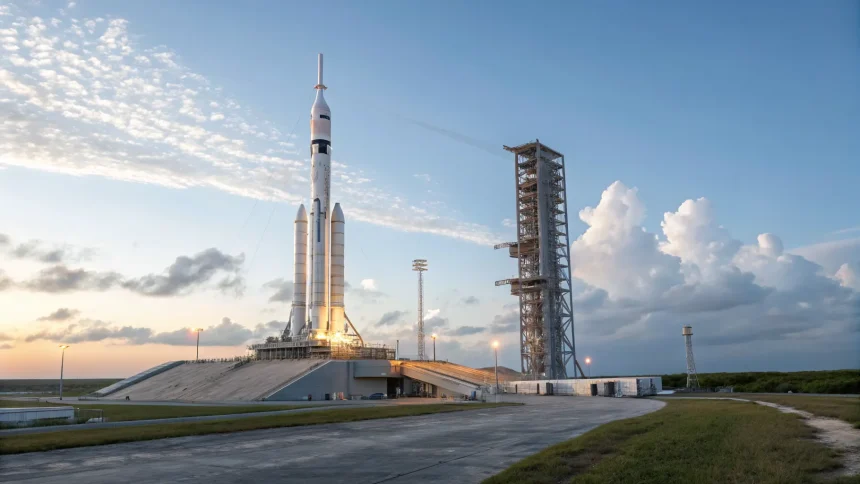
NASA signaled that its next crewed mission around the Moon could launch as early as April, marking the agency’s first human lunar flyby in more than five decades. The flight, known as Artemis II, will send four astronauts on a ten-day journey to test systems needed for future landings and long-duration missions. The timing reflects both steady progress and lingering technical work that must finish before liftoff from Florida.
NASA is now looking at an April launch at the earliest for Artemis II, its first crewed lunar flyby in more than 50 years.
Why Artemis II Matters
Artemis II is designed to prove that Orion’s life support, navigation, and heat shield can handle a crew on a deep-space trip. It follows Artemis I, the uncrewed test flight that orbited the Moon in late 2022 and splashed down in the Pacific. That mission showed the Space Launch System (SLS) rocket and Orion capsule could fly, but it also raised engineering questions. Engineers have since examined the Orion heat shield’s char layer performance and fine-tuned systems that will keep astronauts safe.
The crew—Reid Wiseman, Victor Glover, Christina Koch, and Jeremy Hansen—will be the first to travel near the Moon since Apollo. Their flight plan includes high-speed reentry to stress the heat shield and a distant lunar flyby to validate deep-space operations. Success would clear the path for Artemis III, which aims to land astronauts near the lunar south pole.
A Program Built on Milestones and Delays
NASA’s moon program has faced shifting timelines. Supply chain strains, complex testing, and safety reviews have pushed earlier targets. Artemis II cannot launch until Orion’s environmental control and life support hardware complete crewed testing. Ground systems at Kennedy Space Center must also pass integrated checks with SLS. These steps are designed to reduce risk during ascent, deep-space flight, and splashdown.
The last crewed lunar mission, Apollo 17 in 1972, ended the first Moon era. Artemis seeks to establish a steady cadence of missions with international and commercial partners. The strategy calls for cislunar infrastructure, new spacesuits, and a human landing system. Each piece must be ready at the right time, which makes schedule coordination a constant challenge.
What Must Happen Before Launch
NASA and its contractors have outlined several near-term tasks that drive the schedule. A clear April window depends on finishing these items and on-range availability at Cape Canaveral.
- Complete verification of Orion life support and cabin pressure controls with crew involvement.
- Resolve heat shield data items from Artemis I and confirm final flight configuration.
- Finish avionics and software tests across SLS, Orion, and ground systems.
- Conduct a full-up rehearsal on the launch pad, including countdown operations.
- Close out open hazard analyses and certify emergency escape procedures.
Program officials have stressed that safety will set the pace. Any new findings could shift the date again. The “at the earliest” phrasing signals flexibility and a focus on risk reduction.
Voices, Risks, and the Bigger Picture
Astronauts have framed the mission as a proving ground for long trips to the Moon and later to Mars. Industry partners view Artemis II as a confidence builder for the SLS-Orion stack. International partners see it as a step toward shared lunar science and technology work. Critics point to cost and schedule pressure, urging tighter oversight and more reusable systems.
The stakes are high for every subsystem. Life support must run smoothly for the full mission. Communications must hold during deep-space passes. The heat shield must survive a reentry speed near 25,000 mph, producing extreme temperatures at the plasma interface. Lessons from this flight will shape designs and operations for years.
What Success Would Unlock
If Artemis II flies on time and performs as planned, NASA can focus on landing readiness. That includes new spacesuits for surface work, a lunar lander developed with commercial partners, and planning for sustained operations near the south pole. A clean flight would also support international commitments under the Artemis Accords and encourage private investment in cislunar services.
If issues arise, the program could pause to address them, adding months to the timeline. Either way, data from a crewed lunar flyby will guide the path to a landing and a permanent presence in lunar orbit.
For now, an April launch remains a working target, not a guarantee. The next updates will come as testing wraps and hardware moves to the pad. Watch for final certification milestones, a rehearsal on the crawlerway, and a formal launch date announcement. The mission’s outcome will shape human deep-space exploration for the next decade.