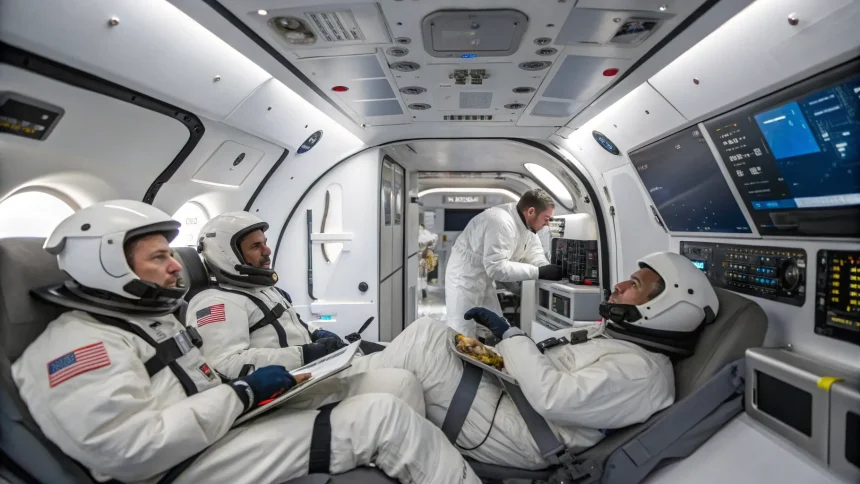
NASA’s next crewed flight to the Moon’s neighborhood will test more than engines. It will test how four people live, work, eat, and sleep inside Orion for days at a time. The mission, Artemis II, will fly a crew around the Moon and back, checking every system needed before a lunar landing attempt. The flight will launch from Florida and spend roughly 10 days in space, serving as a shakedown cruise for deep-space travel.
“Here is what life will be like for the four astronauts onboard the Orion spacecraft during the Artemis II mission.”
The statement echoes the core question driving public curiosity. What does day-to-day life look like when Earth is a blue marble outside the window and every resource is finite?
Background: A Dress Rehearsal for Deep Space
Artemis II follows an uncrewed test that sent Orion around the Moon to prove it could survive deep space and reentry. This time, four astronauts will ride the same spacecraft to validate life-support, navigation, and crew operations. Orion is larger than Apollo’s command module, but it is still compact. Every habit, from brushing teeth to troubleshooting a sensor, follows a checklist.
NASA frames the mission as the last major step before a landing attempt. Crew health, habitability, and workload are as central as propulsion. If something is uncomfortable or confusing at day three, it can be a hazard by day eight.
Daily Rhythm: Work, Meals, and Maintenance
Life in Orion follows a tightly planned schedule. The crew will rotate tasks so that flight operations, system checks, and navigation updates continue without gaps. Work periods are balanced with meals, exercise, and rest to keep minds sharp.
- System checks: power, thermal control, and life support get regular reviews.
- Navigation: star trackers and ground updates guide the lunar flyby.
- Housekeeping: wiping surfaces and securing gear manages crumbs and clutter in microgravity.
Meals come from thermostabilized pouches and bars designed for nutrition and shelf life. Hot water helps rehydrate some foods. Taste can dull in microgravity, so spices matter. Crew members usually personalize menus during training to find options that agree with them.
Sleeping in Microgravity
Each astronaut will secure a sleeping bag to a wall or bunk to keep from drifting and bumping gear. Earplugs cut the hum of fans and pumps. Lighting is dimmed on a schedule to match a normal day-night cycle and support sleep quality. Short naps may be used during high-workload days, such as the outbound and return legs.
Staying Fit and Healthy
Exercise is nonnegotiable. Resistance bands and compact devices help counter muscle and bone loss. Even a short daily workout supports mood and reduces injury risk. Hygiene is a kit of wipes, rinse-free soap, and careful water use. Waste systems are compact and well rehearsed on the ground to avoid mid-mission surprises.
Medical kits include tools for minor injuries, motion sickness, and routine checks. Crew members train to assist one another, since there is no quick ride home.
Communication and Morale
Voice and data links keep the crew in touch with Mission Control and family. Delays are short near Earth and grow slightly as Orion swings around the Moon. Video messages and scheduled private calls help maintain morale.
Small comforts matter. Photos, a playlist, or a lighthearted ritual can steady nerves during long stretches. Crew cohesion is part of the flight plan, not an afterthought.
Testing for the Long Haul
Every routine aboard Artemis II is a test case for future missions that will last longer and go farther. If a meal routine saves time or a workout plan reduces fatigue, it becomes part of standard practice. If a sensor readout confuses a tired crew member, engineers adjust software or procedures before the next flight.
NASA officials say this mission is a bridge from laboratory tests to real-world use. The results will shape cabin layouts, menu choices, and exercise hardware for future crews headed for lunar orbit and, later, longer expeditions.
What to Watch
Observers will track three big questions:
- Does Orion’s life-support system handle continuous use without hiccups?
- How well do sleep and exercise plans sustain alertness by the end of the trip?
- Which cabin procedures save time and reduce errors during busy phases?
Artemis II is more than a flight around the Moon. It is a human factors trial, a test of how people and spacecraft share a small room for days while doing complex work. If the crew returns rested, healthy, and with a tidy to-fix list, the program moves closer to planting new boot prints on the lunar surface. The next steps depend on what the crew learns about living well in deep space—and how quickly teams on the ground can turn those lessons into safer, smarter missions.