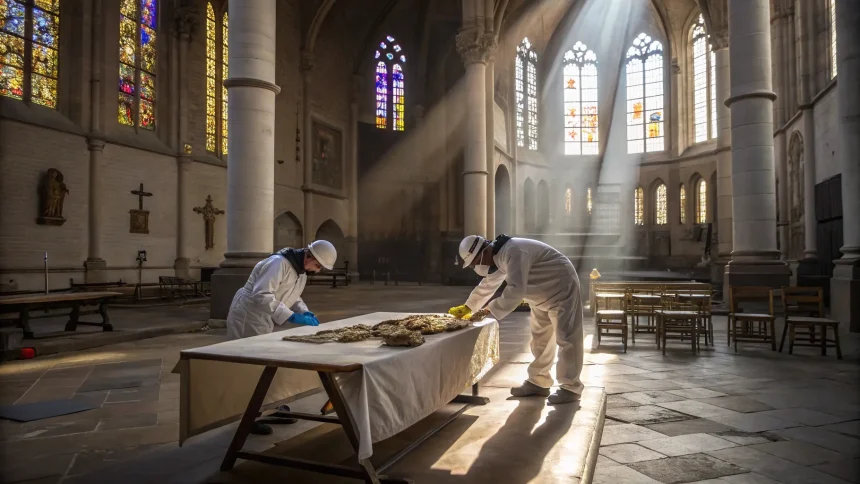
Archaeologists in the Netherlands have uncovered human remains in a church that may belong to d’Artagnan, the famed French officer who inspired The Three Musketeers. The discovery has stirred fresh interest on both sides of the border, raising hopes that science and archives can settle a mystery lingering since the 17th century. If confirmed, the find would tie a literary legend to a precise place and story in European history.
The remains were found during work at a church site in the Netherlands. Early clues suggest a burial dating to the late 1600s. Investigators now face a detailed process to test whether the bones match the man hailed in Alexandre Dumas’s classic novel and rooted in real events.
Human remains found in a church in the Netherlands could be those of d’Artagnan, one of the legendary French swordsmen who inspired the novel The Three Musketeers.
A Soldier Behind the Legend
D’Artagnan was not only a character in fiction. Historians identify him as Charles de Batz de Castelmore, known as d’Artagnan, a Gascon noble who rose through the ranks in the service of the French crown. He served in the Musketeers of the Guard and later became a senior officer.
He died in 1673 during the Franco-Dutch War at the Siege of Maastricht, a city now in the southern Netherlands. Accounts describe him falling in battle as French troops tried to breach defenses. For centuries, his exact burial place remained unclear, feeding rumor and scholarly debate.
Alexandre Dumas’s 1844 novel turned the name into a symbol of courage and loyalty. Yet the real d’Artagnan’s final resting site stayed uncertain, even as memorials and statues honored him in France and the Netherlands.
How Investigators Could Verify the Claim
Experts typically rely on a mix of archaeology, forensic science, and historical records to confirm identities. In this case, any match would require several lines of evidence to align.
- Radiocarbon dating to place the remains in the correct century.
- Isotope analysis to indicate geographical origin and diet consistent with a French noble.
- Forensic study of age, injuries, and stature compared with known descriptions.
- Archival research on church burials linked to the 1673 siege.
- Possible DNA comparisons with verified relatives, if any records and samples exist.
Each step carries limits. Many church records were lost to war, neglect, or reform. DNA may be hard to recover from centuries-old bones. Even a strong clue, such as period clothing fragments or a military clasp, would not be final proof by itself.
Why This Matters in France and the Netherlands
The find arrives at a time of renewed public interest in historical identification projects. Past cases, such as the discovery of King Richard III under a car park in Leicester, showed how science can resolve open questions and reshape public memory. A confirmed burial for d’Artagnan could add depth to Franco-Dutch history and tourism.
Local heritage groups are likely to see new attention. Museums in both countries could gain material for exhibits on the Franco-Dutch War, military life in the 1600s, and the link between history and fiction. Schools may revisit the period with new sources and lessons.
There are also cautions. Cities have learned that sudden fame can strain sites without proper planning. If the burial is confirmed, preservation, funding, and crowd management would follow.
Balancing Hopes With Evidence
Some historians urge patience. They point out that many officers fell at Maastricht, and high-status burials in churches were common. A grave from 1673 near the siege does not, on its own, settle identity. Others argue that the combination of place, period, and possible artifacts could narrow the field quickly.
Archaeologists commonly publish interim reports before final peer review. That process can take months. The most persuasive cases blend material finds with precise archival links, such as parish entries naming the dead, or letters describing funeral rites in a specific church.
What Comes Next
Teams will likely clean and catalog the remains, gather small samples for lab work, and compare results with 17th-century records in France and the Netherlands. Any hint of family links might point to DNA leads. Officials, if involved, could announce staged updates to avoid speculation.
For now, the claim stays cautious: a possible match, not a fact. Yet the prospect has already sparked public curiosity. It brings focus to a soldier whose life bridged court politics, war, and legend.
If science and documents align, the find could settle a long-running question and give Europe a new site of shared memory. If not, the work will still enrich the record of a violent year at Maastricht. Either way, the coming tests will shape how readers and historians view the line between Dumas’s story and the man who helped inspire it.