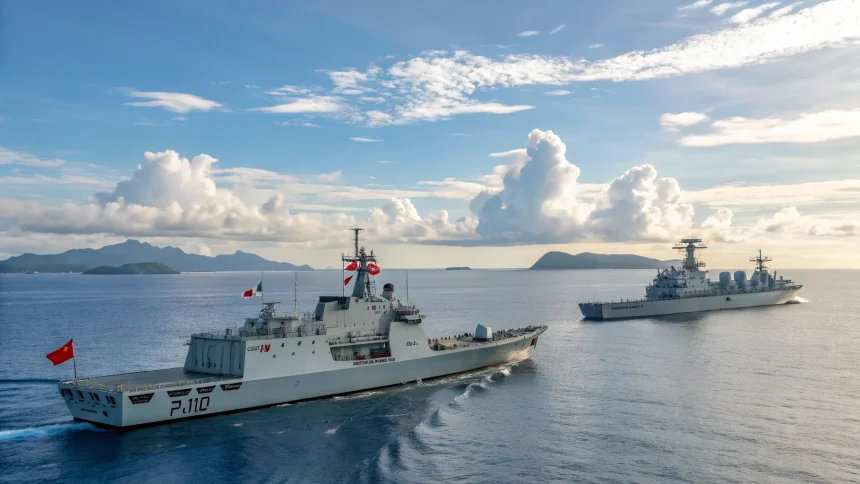
China warned the Philippines on Monday following a fresh clash near disputed islands in the South China Sea, urging Manila not to challenge Beijing’s efforts to defend what it calls its territory. The incident involved vessels from both countries in contested waters, intensifying a standoff that has drawn regional and global concern.
Beijing framed the confrontation as a response to a challenge near the islands, while Manila has long maintained its ships operate lawfully in waters it considers part of its exclusive economic zone. The warning signals more friction ahead as each side tests limits at sea and seeks support on land.
Beijing’s Message and Manila’s Position
China’s statement was direct, emphasizing its claim to sovereignty and maritime rights across key areas of the South China Sea.
China urged the Philippines to not challenge its efforts to “safeguard its territorial sovereignty and maritime rights and interests.”
Philippine officials have repeatedly argued that their vessels operate within a 200-nautical-mile exclusive economic zone, a boundary recognized under international law. They also cite a 2016 ruling by an international tribunal in The Hague, which invalidated many of China’s expansive claims. Beijing rejects that ruling and continues to patrol and build up features across the contested waters.
Why the Waters Matter
The South China Sea is one of the world’s busiest shipping routes. It is rich in fish and may hold significant oil and gas reserves. Multiple countries claim features there, but China asserts control over most of the sea through its “nine-dash line,” a claim widely disputed by neighbors.
Clashes at sea have risen in recent years. The Philippines has reported incidents involving water cannons, shadowing maneuvers, and collisions with Chinese vessels near contested shoals and reefs. China says its coast guard and maritime militia act to prevent “intrusions” and protect safety at sea.
Rising Risks and Regional Stakes
The latest confrontation adds stress to a volatile area where small mistakes can escalate. Each incident tests not only seamanship but also political resolve. It also raises questions about crisis management between the two countries, which have hotlines and protocols but limited success in preventing run-ins.
- Busy shipping lanes carry trillions of dollars in trade each year.
- Fisheries support millions of livelihoods across Southeast Asia.
- Energy exploration plans hinge on access and legal clarity.
All of this puts pressure on governments to show resolve without tipping into open conflict. Analysts say both sides are unlikely to give ground on core claims, making incidents more likely even as diplomats talk.
International Law and Security Ties
International law grants coastal states rights to resources within their exclusive economic zones. The 2016 tribunal ruling sided with the Philippines on key issues, but it has no direct enforcement mechanism. China maintains that history and its own laws back its claims.
The Philippines has deepened security ties with partners, citing the need for deterrence and support for maritime patrols. The United States has reaffirmed that its mutual defense treaty with Manila covers armed attacks on Philippine forces in the South China Sea. Japan and Australia have also increased joint exercises and capacity-building efforts with the Philippines.
Economic and Social Impact
Repeated clashes disrupt fishing and raise insurance costs for shipping. Fisherfolk in the Philippines report lost income when access is blocked near traditional grounds. Chinese authorities say they must manage safety and order, including conservation rules and navigation control.
Energy projects face uncertainty as firms weigh legal risk and physical access. Without a stable framework, investments stall, hurting regional growth prospects.
What Comes Next
Diplomats are likely to push for talks after the latest clash, including efforts to advance a long-discussed regional code of conduct. Progress has been slow. Key questions remain about how to define acceptable behavior at sea and how to verify it.
Maritime experts warn that more close encounters are likely unless clear rules and communications are in place. De-escalation steps could include improved incident reporting, agreed distances for maneuvering, and third-party observation during sensitive missions.
The warning from Beijing marks another tense moment in a long-running dispute with no easy fix. Manila is expected to continue asserting rights under international law. China shows no sign of retreating from its claims. The region will watch for whether the two sides can manage encounters at sea, reduce the risk of injury, and keep trade moving. The next test may come with the very next patrol.