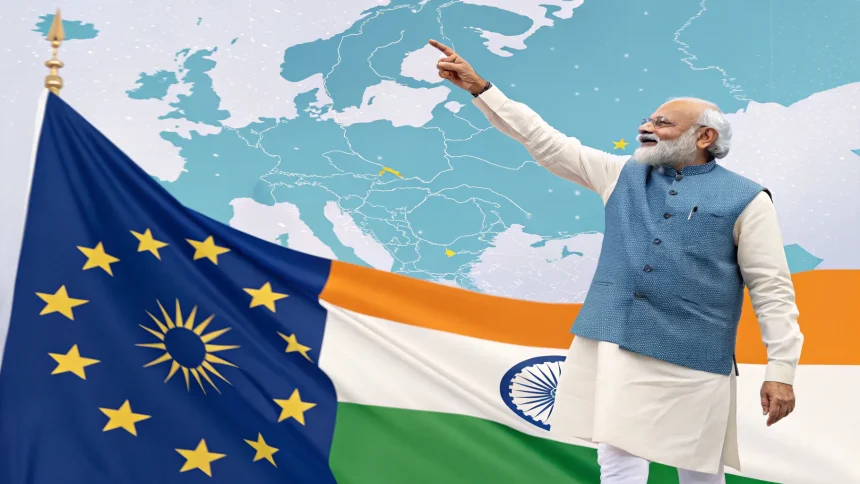
India’s prime minister said the country has reached a free trade agreement with the European Union, signaling a potential shift in one of the world’s key economic relationships. The declaration points to a breakthrough after years of stop-start talks between New Delhi and Brussels. Details on the scope, timelines, and ratification steps were not immediately available.
If confirmed, the pact could reshape tariffs, market access, and regulations for businesses across both regions. It would also test how two large democracies balance trade growth with rules on labor, environment, and data.
“India’s prime minister says it has reached a free trade agreement with the European Union.”
Long Road to a Deal
India and the EU began negotiating a comprehensive trade pact in 2007. Talks stalled in 2013 amid disagreements over tariffs, services access, and intellectual property. Negotiations restarted in 2022 with new working groups and a push from both sides to deepen economic ties.
The EU is among India’s largest trading partners. Two-way goods trade is valued at more than €100 billion a year, with services adding tens of billions more. India exports textiles, pharmaceuticals, and IT services, while the EU sells machinery, vehicles, and chemicals into the Indian market.
Past sticking points included tariff cuts on European cars and spirits, data rules for digital services, and protections for European geographical indications. India sought easier movement for skilled workers and better access for its service firms.
What Could Be in the Pact
While official texts were not released, recent rounds focused on a broad set of issues. Negotiators have weighed tariff reductions, services access, investment rules, and standards alignment.
- Tariffs: Phased cuts on industrial goods and select agricultural items.
- Services: Expanded access for IT, finance, and professional services.
- Regulation: Rules on data flows, privacy, and digital trade.
- Sustainability: Labor and environmental provisions tied to enforcement.
- Geographical indications: Protection for EU products and Indian specialties.
Any alignment with the EU’s climate policies, including its carbon border measure, will draw close scrutiny from Indian exporters in steel, cement, and aluminum. Clear timelines and transition support would be key to easing industry concerns.
Industry Impact and Winners to Watch
Automakers could gain from lower tariffs, but local content rules and safety standards will matter. European brands have long sought easier entry to India’s growing car market. Indian component makers may see chances to scale up their supply roles.
Spirits and wine are another area to watch. The EU has pressed for lower duties on premium alcohol. India’s domestic producers, and state tax regimes, could shape how any cuts play out at retail.
Pharmaceutical makers may benefit from stable regulatory pathways, though intellectual property terms will be closely read. India’s role as a global supplier of generics means pricing and access are sensitive issues.
IT and business services stand to gain if visas, recognition of qualifications, and data rules improve. Small and medium enterprises could find new buyers in Europe if paperwork and standards checks are simplified.
Agriculture will be complex. The EU seeks protections for products like cheeses and meats. India wants recognition for items such as basmati rice and regional teas. Labeling and testing rules can be as important as tariffs for these goods.
Politics, Process, and What Comes Next
The announcement will now face formal legal checks and likely a ratification process on both sides. In the EU, member states and the European Parliament would need to approve a final text. India will move through its own review and implementation steps.
Business groups will press to see schedules on tariff cuts and the fine print on standards. Labor and environmental groups will examine enforcement mechanisms for any sustainability pledges.
EU officials have in the past cautioned that nothing is final until texts are closed and vetted. Markets will watch for confirmation from Brussels and a publication of the agreed chapters.
Why It Matters
Global supply chains are shifting, and both India and the EU want dependable partners. A deal could diversify sourcing for Europe and open capital and technology flows into India. It may also influence other trade talks under way in Asia and the Indo-Pacific.
For consumers, gradual tariff cuts can lower prices on select imports. For exporters, predictable rules reduce risk and planning costs. The scale of the impact will depend on how deep the commitments run and how quickly they take effect.
The prime minister’s statement marks a major step, but the test will be the text and the timeline. Watch for confirmation from EU institutions, the release of tariff schedules, and clarity on digital and climate rules. These details will show how soon businesses and workers feel the change—and where the real gains will land.