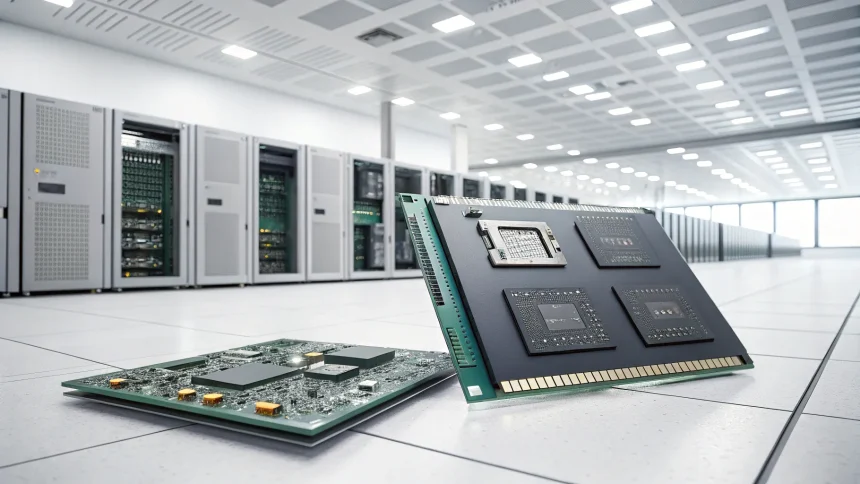
In a bid to cut the soaring power demands of artificial intelligence, Neurophos is developing an optical chip designed to run AI models far more efficiently. The effort targets inferencing, the step where trained models answer user prompts. The company says its approach, which uses a composite material for computation, could lower energy use while keeping performance high.
The push comes as data center electricity consumption grows with the spread of AI features in consumer apps and enterprise tools. Power limits are now a real constraint on where and how quickly new capacity can be built. Hardware makers are racing to deliver faster chips that use less electricity per task.
A New Take on AI Inferencing
Neurophos describes a chip that performs math with light, not electrons. The focus is on the linear algebra at the heart of neural networks, where matrix multiplications dominate compute costs. By routing light through carefully engineered materials, photonic circuits can execute these operations in parallel with very low heat.
“Neurophos is taking a crack at solving the AI industry’s power efficiency problem with an optical chip that uses a composite material to do the math required in AI inferencing tasks.”
Optical computing has drawn attention for its potential energy savings, especially at large scale. The company’s nod to a composite material suggests a tailored medium that manipulates light to represent weights and perform calculations.
Why Power Efficiency Matters Now
AI services have grown into a new baseline for search, productivity, and customer support. Each query can trigger billions of operations. Multiply that across millions of users, and power requirements add up quickly.
Cloud operators are adding new capacity, but many sites are power-constrained. Local grids and permitting sit in the way. Hardware efficiency is the fastest lever left to pull. Any drop in energy per inference can cut costs and carbon output.
The Photonics Promise—and Problems to Solve
Using light can offer speed and low energy use, but adoption faces hurdles. Analog noise, calibration drift, and temperature effects can degrade accuracy. Packaging photonic parts with control electronics is still complex. Software stacks must map neural networks to optical hardware without losing accuracy.
Companies such as Lightmatter, Lightelligence, and Celestial AI have pursued photonic accelerators for several years. Their progress shows both the promise and the engineering lift involved. Neurophos joins this group with a focus on inferencing, where latency and efficiency matter most to customers.
How It Could Fit Into AI Workflows
Inferencing differs from training. Training is compute-heavy and flexible on latency. Inferencing must respond in real time and often runs at the edge or in strict service-level windows. That makes it a strong target for specialized chips.
If the optical approach integrates with standard frameworks, it could slot into existing model serving stacks. The key test will be end-to-end performance per watt on common models. Support for quantization, batching, and memory bandwidth will also factor into real-world gains.
What Experts Will Watch
- Measured energy per token or per inference on popular models.
- Accuracy stability across temperature and time.
- Compatibility with PyTorch, TensorFlow, and serving tools.
- Manufacturing yield and packaging costs.
- Networking to scale across many accelerators.
Market Impact and Competition
AI accelerators are a crowded field. General-purpose GPUs keep improving. New architectures from established chipmakers are entering the fray. Startups are carving out niches in efficiency or latency.
An optical inferencing chip that hits strong performance-per-watt could win in data centers that are power-limited. It could also serve telecom or edge settings where cooling is tight. Success would likely depend on a software toolchain that reduces friction for developers and operators.
Neurophos is staking its claim on the biggest cost driver in AI operations: energy. The company’s optical route aims to convert the core math of neural networks into light-based operations that sip power. The idea is clear, but delivery will hinge on measured results, software support, and production scale. If the hardware meets its goals, it could help ease grid pressure and lower AI service costs. Watch for third-party benchmarks, early customer pilots, and signals that major cloud platforms plan to support the technology.