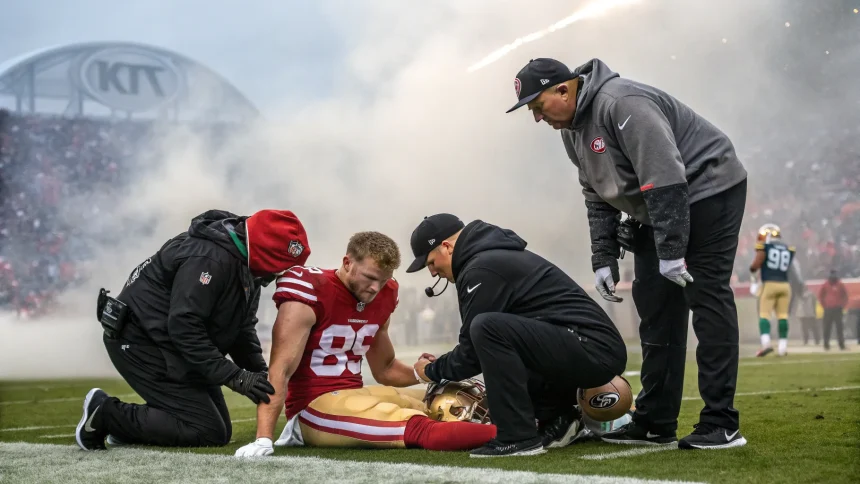
San Francisco tight end George Kittle left the team’s playoff game against the Philadelphia Eagles in the second quarter after an Achilles injury, a blow to an offense built around his power and timing. He was carted to the locker room as teammates looked on, and his status for the rest of the game — and the postseason — immediately became the central question.
The injury happened during a high-stakes meeting between two NFC heavyweights. Medical staff attended to Kittle before he was taken off the field. The team did not immediately announce the severity.
What Happened
“George Kittle was carted off the field during the second quarter of the team’s playoff game against the Eagles after suffering an Achilles injury.”
Achilles injuries can range from a strain to a full rupture. On-field evaluations often focus on strength, pain, and ankle stability. Final diagnoses typically follow imaging after the game. The cart ride suggests concern, but it does not confirm a specific grade.
Why It Matters for San Francisco
Kittle is the offense’s Swiss Army knife. He sets edges in the run game and punishes tacklers after the catch. When he motions pre-snap, defenses shift and hesitate. That delay opens lanes for backs and creates space for receivers.
He is also a trusted safety valve on third down and in the red zone. Without him, play-action loses some bite and the playbook thins on early downs. Backup tight ends can fill roles, but replacing Kittle’s snap-to-snap impact is hard.
Against the Eagles’ front, his blocking usually helps neutralize pressure and widen rushing lanes. A sudden absence forces San Francisco to adjust protections, rely more on quick throws, or lean on extra linemen, each with trade-offs.
Kittle’s Track Record and Role
Kittle is a multiple-time Pro Bowler and All-Pro known for his physical style. His yards-after-catch runs have defined big moments, and his willingness to block sets a standard in the tight end room.
He has played through bumps before, but the Achilles is different. Players often describe the area as tight and unforgiving late in the season. That adds weight to the team’s decision-making during a playoff push.
Achilles Injuries: What We Know
Achilles injuries vary widely. A strain can sideline a player for weeks. A complete tear usually ends a season and starts a long rehab.
- Initial tests check calf strength and tendon integrity.
- Imaging after the game confirms severity.
- Recovery from a rupture often spans 9–12 months, depending on surgery and rehab.
Teams often limit information on game day. The goal is to avoid premature calls while specialists review scans. Expect updates after imaging and consultations.
How the 49ers Could Adjust
San Francisco has options, none perfect. They can feature two-back sets to add protection and keep the run game honest. They can feed quick-game routes to wide receivers to replace some of Kittle’s touches. They can also move the pocket to buy time against the pass rush.
Screen plays and misdirection can help. So can tempo. But the chemistry between quarterback and Kittle in high-leverage spots is hard to replicate.
What’s Next
The next step is clarity. The team will likely run imaging to determine whether Kittle suffered a strain or a tear. The result guides treatment and any decision about his availability.
If he cannot return, the staff must recalibrate on short notice. That means reworking red-zone packages and third-down calls and leaning on depth at tight end and wide receiver.
For now, the 49ers face a test of flexibility and nerve. If the news is better than feared, Kittle could still help in limited snaps. If it is worse, San Francisco’s path gets steeper. Watch for an official update after medical evaluation, and watch how the offense shifts its rhythm in his absence.