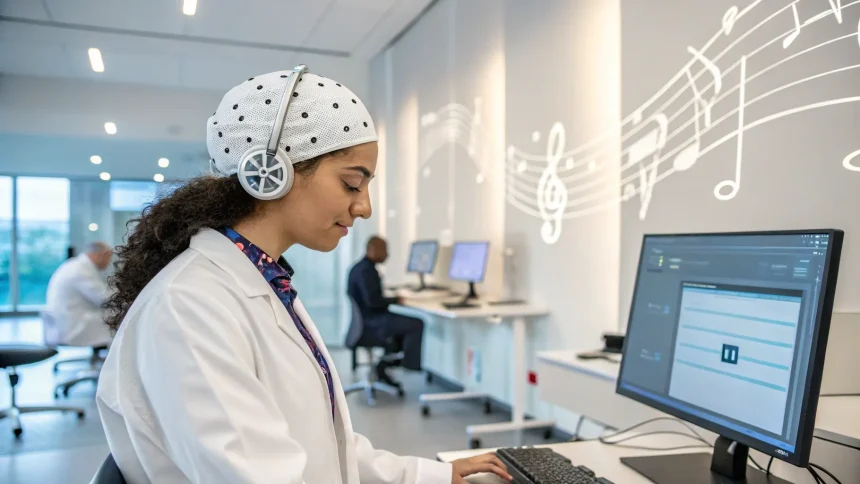
At MIT’s Media Lab, doctoral student Kimaya Lecamwasam is uniting neuroscience, artificial intelligence, and music to study how sound can support mental health. Her work seeks to map how the brain responds to music and identify patterns that could help reduce stress, ease anxiety, and improve daily well-being.
Lecamwasam’s research arrives as clinicians and technologists search for low-cost tools for mental health care. Music is easy to access, and new data methods can help tailor it to individual needs. The goal is simple: make support more personal, timely, and effective.
The Project at a Glance
“I use neuroscience, AI, and music to explore the impact of music on mental health and well-being,” said Kimaya Lecamwasam, a Media Arts and Sciences doctoral student at MIT.
Her approach combines brain and behavioral measures with machine learning that reads patterns in how listeners react. By analyzing changes in mood, attention, and stress markers, the research tests which musical features help most. It also looks at when and for whom those features work.
The core idea is to match music’s structure—rhythm, tempo, harmony—to a person’s state in the moment. Small shifts can matter, such as a slower tempo during stress or a steady beat to aid focus.
Why Music and Mental Health Matter
Mood disorders and anxiety now affect hundreds of millions worldwide. Many people face long waits or limited access to care. Music offers a familiar option for self-management during those gaps.
Research across hospitals and community programs has linked music-based interventions with improved mood and reduced anxiety. Studies have also found changes in physiological markers such as heart rate and cortisol during listening and active music-making. While results vary, the pattern is encouraging.
Digital platforms have expanded access to playlists and guided sessions. Yet most tools still rely on trial and error. Lecamwasam’s work aims to bring more precision by pairing listening data with brain and behavioral signals.
How AI and Neuroscience Fit In
Neuroscience helps explain why music can shift mental states. Specific rhythms can regulate breathing. Melody can cue memory. Harmony can affect emotional tone. Brain imaging and wearable sensors track these responses across time.
AI models can then map which musical features link to improved outcomes for a given person. Over time, the system can recommend content that meets a listener where they are. It can also adapt as needs change.
- Track moment-to-moment responses to sound.
- Identify musical features tied to calmer states.
- Suggest personalized playlists or live adjustments.
This approach could support many settings, such as pre-procedure anxiety, workplace stress, or recovery after a hard day. It can also complement therapy, not replace it.
Promise, Limits, and Ethics
Specialists in mental health see promise in safer, non-drug options that fit into daily life. Still, they warn that music’s effects can be personal and context-dependent. What calms one listener may unsettle another. Cultural background and memories also shape reactions.
Strong evidence for clinical use requires careful trials, clear measures, and diverse participants. Data privacy is another concern. Any system capturing brain or mood signals must protect users and be transparent about how recommendations are made.
Lecamwasam’s focus on measurable outcomes and individualized patterns addresses these points. It also aligns with broader efforts to make digital health tools more inclusive and accountable.
What to Watch Next
As models improve, researchers expect better matching between musical features and desired outcomes, such as reduced stress or improved sleep. Wearables can provide feedback on heart rate, breathing, and attention, helping refine recommendations.
Partnerships with clinicians and music therapists will be key. These teams can test when personalized music helps most, and where it should be paired with counseling or medication. They can also set standards for safety and equity.
Lecamwasam’s work points to a near-term future where music functions as a timely, data-informed support. The clearest takeaway is practical: with the right feedback and safeguards, a familiar tool could help many people feel better, sooner.