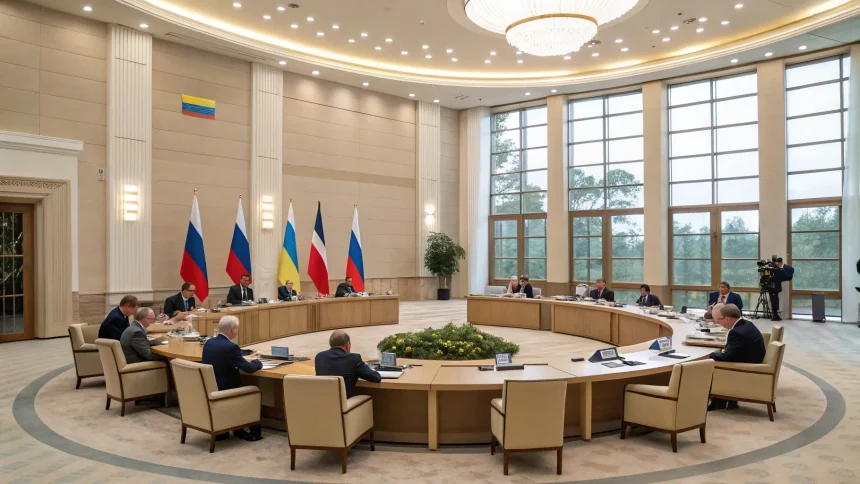
Peace talks over a U.S.-proposed plan to end the nearly four-year war in Ukraine moved ahead in Florida, with both Russian and Ukrainian sides signaling progress. A Kremlin envoy described the discussions as productive, while Ukraine’s president said the pace had picked up. The rare alignment of tone suggested a window for diplomacy as negotiators tested whether core demands could be narrowed into a workable deal.
Careful Optimism From Both Sides
Russian and Ukrainian messages were measured but positive. The Kremlin representative praised the tone of the meetings, signaling space for technical work on draft language. The Ukrainian leader stressed speed and momentum, hinting at a timetable that favors early steps to reduce fighting.
“Constructively,” a Kremlin envoy said of the talks in Florida.
The Ukrainian president said the process was moving “quickly.”
Public comments were brief, leaving details of the U.S.-backed plan unclear. Still, the synchronized signals stood out after years of hardened positions and stalled channels.
Background: A War Nearing Four Years
The conflict began in February 2022 and has reshaped security in Europe. Casualties have been heavy, millions have been displaced, and energy and grain markets have swung. Previous talks early in the war, including sessions in Belarus and Turkey, did not yield a lasting cease-fire. A Black Sea grain export deal, brokered in 2022, offered limited relief before collapsing. Since then, missile strikes, drone attacks, and trench warfare have defined the front.
Diplomacy has flickered at times, often linked to prisoner exchanges and humanitarian corridors. Wide gaps over territory, security guarantees, and sanctions have blocked broader agreements.
Key Issues Likely On The Table
While negotiators kept the Florida agenda private, long-standing disputes shape any path to a deal:
- Security guarantees for Ukraine to deter future attacks.
- Control of occupied territories and lines of control.
- Verification and monitoring of any cease-fire.
- Sanctions relief and sequencing tied to compliance.
- Prisoner exchanges and returns of displaced civilians.
- Safe corridors for energy and grain exports.
The order of steps often matters more than the steps themselves. Each side wants its priorities front-loaded, with penalties for violations clearly defined.
The U.S. Role And International Stakes
The United States convened the Florida talks and proposed the current plan, highlighting Washington’s central role. European allies have pushed for a durable security framework to prevent relapse into fighting. Countries in Africa, the Middle East, and Asia are watching food and fuel flows that hinge on stable Black Sea traffic.
Global markets often react to even small signals. A credible cease-fire could ease insurance costs for shipping and stabilize energy prices. A breakdown could trigger renewed supply shocks.
What A Deal Could Look Like
Any agreement would likely start with a monitored halt to hostilities, followed by phased steps. These could include prisoner swaps, humanitarian access, and limited demilitarized zones. Verification by neutral monitors would be key to sustaining trust between rounds of implementation.
Hard choices would remain. Territorial claims are the hardest barrier. Security guarantees that satisfy Kyiv without triggering wider escalation are another test. Sanctions relief tied to benchmarks would require careful drafting to prevent loopholes.
Reasons For Caution
Publicly positive statements do not ensure success. Domestic politics in Moscow and Kyiv will shape red lines. Any shift on the battlefield can change the incentives overnight. Previous talks faltered when expectations ran ahead of enforcement tools.
External actors will also influence outcomes. European capitals want clarity on costs and commitments. Nations that have tried to mediate may seek a seat at the table as the process advances.
The signals from Florida show a narrow opening. Both sides used words that point to workmanlike progress, not a breakthrough. If negotiators can fix the sequence of steps and set up credible monitoring, the talks could move from hopeful language to written terms. For now, the world will watch for the first concrete deliverable—whether a mutual pause in strikes, a prisoner exchange, or a safe corridor for exports—that proves momentum is real and not just talk.