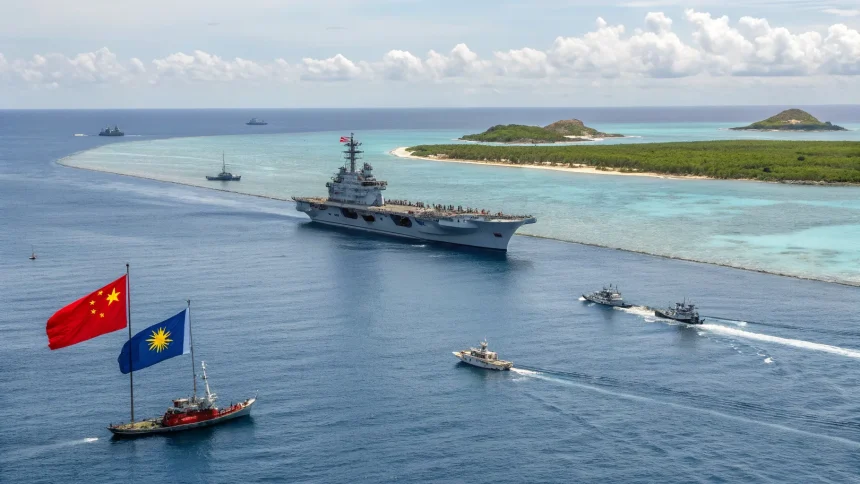
China urged the Philippines on Monday to stop challenging its actions in the South China Sea after ships from both countries clashed near disputed islands. The call came as Beijing said it was acting to protect its claimed waters, while Manila continues regular missions in areas it also claims. The incident adds new tension to one of Asia’s most sensitive flashpoints.
Beijing’s Message and the Latest Encounter
Chinese authorities framed the encounter as a defense of sovereignty. In a statement, Beijing warned Manila against further actions at sea. The timing suggests another run-in during routine patrols and resupply missions that the Philippines conducts to outposts in contested areas.
China urged the Philippines to not challenge its efforts to “safeguard its territorial sovereignty and maritime rights and interests.”
The clash reportedly occurred near disputed islands in the South China Sea, where both sides maintain patrols. Details on damage or injuries were not made public by either side at the time of the statement. Past encounters have included blocked passages, water cannon use, and near collisions.
Background: Long-Running Maritime Dispute
The South China Sea is a key waterway for trade and energy flows. Several countries claim parts of it, including China, the Philippines, Vietnam, Malaysia, Brunei, and Taiwan. China’s claim, outlined by its “nine-dash line,” covers a large area that overlaps with the exclusive economic zones of its neighbors.
In 2016, an international tribunal in The Hague ruled that China’s expansive claim had no legal basis under the U.N. Convention on the Law of the Sea. China rejected the ruling. The Philippines says the award supports its rights to resources and navigation in its exclusive economic zone.
Areas of frequent tension include Second Thomas Shoal, where the Philippines keeps a small outpost on a grounded ship, and Scarborough Shoal, a rich fishing ground. Encounters at these locations have escalated in recent years.
Competing Narratives and Regional Stakes
Beijing argues it is protecting Chinese territory and maritime rights. Manila says its vessels operate lawfully in waters recognized by international law as falling within its economic zone. Both sides accuse the other of unsafe maneuvers at sea.
The dispute draws in outside powers. The United States has a mutual defense treaty with the Philippines and regularly conducts freedom-of-navigation operations. Japan and Australia have increased security cooperation with Manila, citing open sea lanes and respect for international law.
- China cites historical rights to the waters.
- The Philippines cites the 2016 arbitral ruling and UNCLOS.
- Both deploy coast guard and maritime militia vessels in contested areas.
Economic and Security Implications
Shipping worth trillions of dollars passes through the South China Sea each year. Energy exploration and fishing rights are also at stake. Fishermen from both countries have reported losses when access is restricted.
Maritime run-ins heighten the risk of miscalculation. Even minor collisions can spiral if they involve military or coast guard ships. Regional coordination and clearer communication channels could lower the risk of an accident turning into a broader crisis.
What to Watch Next
Analysts will look for more patrols and resupply attempts by the Philippines, and how China responds. Any escalation near Second Thomas Shoal or Scarborough Shoal would be a warning sign. Diplomatic messaging from ASEAN, the United States, and other partners will also be important.
Talks between China and ASEAN on a code of conduct have dragged on for years. Progress there, even incremental, could help reduce incidents. Clear rules for close encounters at sea and hotline use during standoffs would be practical steps.
The latest clash shows how fragile the situation remains. China’s warning marks another sharp exchange amid unresolved claims. Without sustained diplomacy and adherence to international law, more confrontations are likely—and each one carries greater risks for the region’s trade, security, and stability.